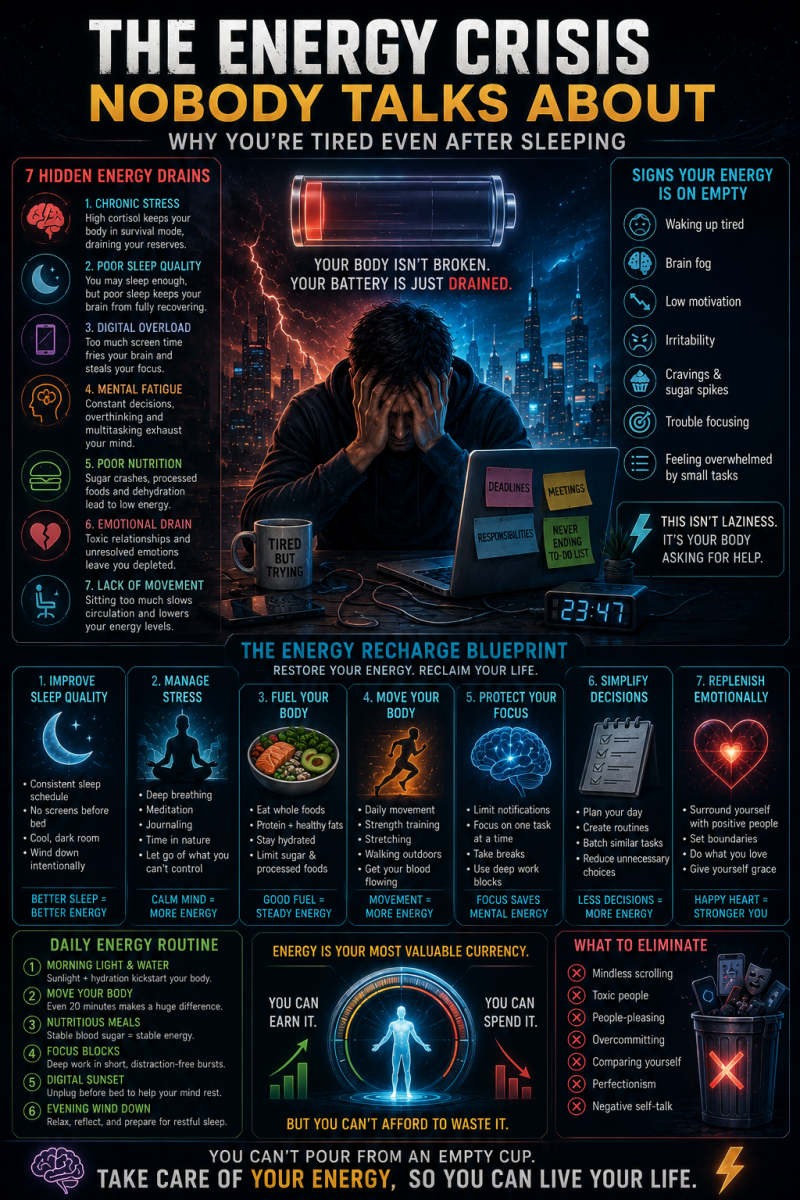
Introduction: You Slept Eight Hours—So Why Do You Still Feel Exhausted?
You went to bed at a reasonable time.
You got what should have been enough sleep.
Yet somehow, you wake up feeling like your mattress secretly hosted a wrestling tournament while you were unconscious.
Your body feels heavy.
Your mind feels foggy.
Your motivation is hiding somewhere under the bed.
And by lunchtime, you're already wondering if a third cup of coffee qualifies as a balanced meal.
Sound familiar?
You're not alone.
Millions of people today are experiencing an invisible energy crisis.
They're tired.
Not because they're lazy.
Not because they're weak.
But because modern life is quietly draining their mental, emotional, and physical energy in ways many don't fully understand.
Why Sleep Isn't Always Enough
One of the biggest misconceptions about energy is that more sleep automatically solves fatigue.
Sleep is essential.
But energy is influenced by far more than hours spent in bed.
Think of your body like a smartphone.
Even if you charge it overnight, certain apps running constantly in the background can drain the battery before noon.
Humans work much the same way.
Important Truth
Fatigue is often less about sleep quantity and more about total life load.
The Hidden Energy Drainers
Many people focus on sleep while overlooking the real culprits.
Let's examine the biggest energy thieves of modern life.
1. Chronic Stress: The Invisible Energy Leak
Stress is not merely emotional.
It's biological.
When stressed, your body releases hormones such as:
- cortisol
- adrenaline
These chemicals are useful during emergencies.
But modern stress isn't usually temporary.
It's constant.
Examples:
- financial pressure
- work deadlines
- relationship tension
- information overload
- uncertainty about the future
The result?
Your nervous system remains activated for long periods.
And that consumes enormous amounts of energy.
Humor Break
Your ancestors used stress hormones to escape predators.
Today we use them to answer emails marked "URGENT" 😄
The Cortisol Problem
Cortisol helps you stay alert.
But elevated cortisol over time can lead to:
- fatigue
- irritability
- poor sleep
- reduced concentration
- burnout
Ironically, stress can make you tired even when you're getting enough rest.
2. Poor Sleep Quality (Not Just Sleep Quantity)
Many people technically sleep.
But they don't recover.
Common sleep disruptors:
- late-night screen exposure
- excessive caffeine
- alcohol consumption
- stress
- inconsistent schedules
Even eight hours of poor-quality sleep can leave you exhausted.
Signs of poor sleep quality:
- waking frequently
- brain fog
- morning fatigue
- difficulty concentrating
- dependence on caffeine
The Digital Sleep Sabotage
Blue light from devices can interfere with melatonin production.
Melatonin helps regulate your sleep cycle.
Scrolling social media at midnight may feel relaxing.
Your brain disagrees.
Reality
Your phone is not a bedtime story.
It's often a stimulation device disguised as entertainment.
3. Mental Fatigue: The Exhaustion Nobody Sees
You don't need physical labor to become exhausted.
Mental effort burns energy too.
Modern professionals spend hours:
- solving problems
- making decisions
- processing information
- switching between tasks
By evening, the brain feels overloaded.
Important Insight
Mental fatigue often feels like:
- lack of motivation
- procrastination
- inability to focus
But the real issue may simply be exhaustion.
4. Decision Fatigue
Every day you make hundreds of decisions.
Some are small.
Some are significant.
Examples:
- what to wear
- what to eat
- how to respond
- what to prioritize
- where to spend money
Each decision consumes mental resources.
By evening, your brain's decision-making capacity decreases.
Humor Break
Ever stand in front of the refrigerator for five minutes wondering what to eat?
That's not necessarily hunger.
That's decision fatigue in action 😄
5. Digital Overload and Information Saturation
Your brain processes enormous amounts of information daily.
Notifications.
Emails.
Social media.
Videos.
News.
Messages.
Alerts.
Updates.
Opinions.
The brain never gets a chance to fully recover.
Result:
- overstimulation
- reduced focus
- mental exhaustion
- shorter attention spans
Truth
Your brain wasn't designed to process the internet for twelve hours a day.
6. Poor Nutrition and Energy Crashes
Food is fuel.
But modern diets often create energy instability.
Common culprits:
- excessive sugar
- ultra-processed foods
- dehydration
- inconsistent eating patterns
These habits contribute to:
- energy crashes
- brain fog
- mood fluctuations
The Blood Sugar Roller Coaster
Quick sugary snacks provide temporary energy.
Then comes the crash.
Suddenly, you're staring at your computer screen, wondering why thinking feels difficult.
Sustainable energy comes from:
- protein
- healthy fats
- complex carbohydrates
- hydration
- balanced meals
7. Emotional Exhaustion
Not all fatigue is physical.
Sometimes you're emotionally tired.
Life demands emotional energy through:
- caregiving
- relationships
- workplace stress
- conflict
- worry
Emotional fatigue often goes unnoticed because it isn't visible.
Yet it can be just as draining as physical work.
Why Motivation Disappears
Many people assume:
"I'm lazy."
But often they're depleted.
Motivation requires energy.
When energy falls, motivation follows.
Important Reminder
Sometimes you don't need more discipline.
Sometimes you need recovery.
The Burnout Connection
Burnout is more than feeling tired.
It is chronic depletion.
Common symptoms:
- exhaustion
- cynicism
- reduced productivity
- emotional numbness
- loss of enthusiasm
Burnout develops gradually.
Like a battery that never receives a full charge.
How to Restore Your Energy Naturally
Let's focus on solutions.
Step 1: Prioritize Recovery, Not Just Sleep
Recovery includes:
- relaxation
- exercise
- social connection
- hobbies
- downtime
Sleep matters.
But recovery extends beyond sleep.
Step 2: Reduce Digital Noise
Your attention is valuable.
Protect it.
Try:
- disabling unnecessary notifications
- scheduling screen-free periods
- limiting doom-scrolling
Step 3: Manage Stress Proactively
Stress management isn't a luxury.
It's maintenance.
Effective tools:
- walking
- meditation
- prayer
- deep breathing
- journaling
- nature exposure
Step 4: Move Your Body Daily
Exercise creates energy.
It sounds counterintuitive.
But movement improves:
- circulation
- mood
- sleep quality
- mental clarity
Even 20 minutes helps.
Step 5: Improve Sleep Hygiene
Simple improvements include:
- consistent bedtime
- cooler bedroom
- reduced evening screen use
- limiting caffeine late in the day
Small adjustments produce significant benefits.
Step 6: Simplify Decisions
Reduce unnecessary mental load.
Examples:
- meal planning
- routines
- automation
- prioritization systems
Less decision-making equals more mental energy.
Step 7: Protect Your Mental Bandwidth
Not every problem deserves your attention.
Not every argument requires participation.
Not every notification deserves an immediate response.
Choose carefully where your energy goes.
Humor Break
Protect your energy like it's your last phone battery percentage at the airport 😄
The Mature Perspective on Energy
As we grow older, we realize something important:
Time is valuable.
But energy may be even more valuable.
Without energy:
- opportunities are missed
- creativity declines
- relationships suffer
- goals remain unfinished
Energy is the fuel behind everything meaningful.
The Energy Formula
If you remember nothing else:
Quality Sleep + Stress Management + Good Nutrition + Movement + Mental Recovery = Sustainable Energy
No miracle supplement required.
Just consistent habits.
Conclusion: Fatigue Is Often a Message, Not a Weakness
If you're constantly tired despite sleeping enough, don't automatically assume something is wrong with you.
Instead ask:
- Am I stressed?
- Am I overstimulated?
- Am I emotionally exhausted?
- Am I recovering properly?
- Am I protecting my energy?
Often, the answer is hidden there.
Final Truth
Your body isn't trying to sabotage you.
It's trying to communicate with you.
Fatigue is not always a flaw.
Sometimes it's a signal.
A rest request.
A call for balance.
A reminder that recovery is not optional.
Because in a world obsessed with productivity, the people who thrive are not those who run the hardest.
They are the ones who learn how to recharge wisely.
Add comment
Comments