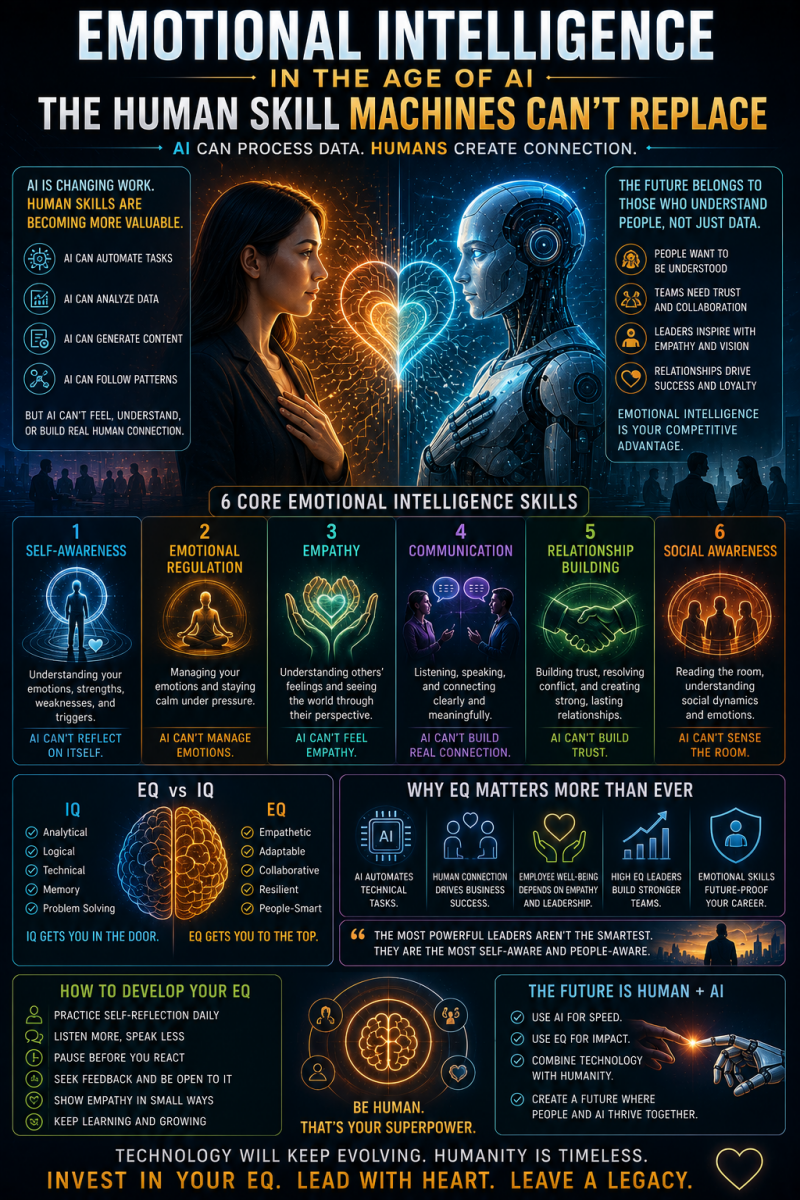
Introduction: The Future Doesn't Belong to Robots—It Belongs to Humans Who Understand Humans
Artificial Intelligence can write reports.
It can generate images.
It can analyze massive amounts of data in seconds.
It can answer questions faster than most people can type them.
In many ways, AI is becoming astonishingly capable.
Yet there is one area where machines still struggle:
Understanding the human experience.
A computer can recognize words.
A human understands the emotions behind those words.
A chatbot can answer customer questions.
A skilled employee can sense frustration, build trust, and calm a difficult situation.
A machine can calculate probabilities.
A leader can inspire hope during uncertainty.
And that's why Emotional Intelligence (EQ) is rapidly becoming one of the most valuable skills in the modern workplace.
As artificial intelligence grows smarter, the qualities that make us uniquely human become more important—not less.
What Is Emotional Intelligence?
Emotional Intelligence, often called EQ, is the ability to:
- understand your emotions
- manage your emotions
- recognize others' emotions
- communicate effectively
- build strong relationships
It is the skill of successfully navigating people.
And since business is ultimately about people, EQ has enormous value.
Simply put:
IQ may help you get hired.
EQ often determines how far you go.
EQ vs IQ: What's the Difference?
For decades, intelligence was measured primarily through IQ.
IQ evaluates:
- reasoning
- memory
- logic
- analytical thinking
These abilities matter.
But they tell only part of the story.
Emotional Intelligence measures:
- empathy
- self-awareness
- communication
- resilience
- leadership
- emotional regulation
Many brilliant people struggle professionally because they lack emotional intelligence.
Meanwhile, individuals with average technical skills often excel because they know how to connect with others.
Humor Break
Some people can solve advanced mathematical equations...
But still send emails that start workplace wars 😄
Why Emotional Intelligence Matters More Than Ever
The workplace is changing rapidly.
Artificial Intelligence is increasingly handling:
- repetitive tasks
- data analysis
- routine customer support
- administrative work
- content generation
As automation expands, human interaction becomes more valuable.
Important Truth
The more technology advances, the more valuable human skills become.
The Human Advantage Machines Can't Replicate
AI can imitate conversation.
It cannot genuinely experience:
- compassion
- disappointment
- gratitude
- loyalty
- trust
- courage
These emotional experiences shape human relationships.
And relationships drive:
- leadership
- teamwork
- sales
- customer service
- negotiation
- collaboration
Skill #1: Self-Awareness
Self-awareness is the foundation of emotional intelligence.
It means understanding:
- your strengths
- your weaknesses
- your emotions
- your triggers
- your behavior patterns
Self-aware people ask:
- Why am I reacting this way?
- What am I feeling?
- How is my behavior affecting others?
Without self-awareness, personal growth becomes difficult.
Truth
You cannot improve what you refuse to understand.
Skill #2: Emotional Regulation
Everyone experiences:
- frustration
- stress
- anger
- disappointment
Emotionally intelligent people don't eliminate these feelings.
They manage them.
Example:
A difficult customer complains.
One employee becomes defensive.
Another remains calm, listens carefully, and resolves the issue.
Same situation.
Different emotional regulation.
Different outcome.
Humor Break
Emotional regulation is choosing not to send that strongly worded email you've already rewritten seven times 😄
Skill #3: Empathy
Empathy is the ability to understand how another person feels.
It is not simply hearing words.
It's understanding the emotions behind the words.
Empathy improves:
- leadership
- customer relationships
- teamwork
- conflict resolution
- communication
People want to feel understood.
And in an increasingly automated world, genuine understanding becomes a competitive advantage.
Important Reminder
People may forget what you said.
They rarely forget how you made them feel.
Skill #4: Communication
Communication is no longer just about sharing information.
It's about creating a connection.
Effective communicators can:
- listen actively
- explain clearly
- adapt their message
- resolve misunderstandings
- inspire action
The AI Era Reality
Information is abundant.
Clear communication is rare.
Skill #5: Relationship Building
Careers are often built through relationships.
Opportunities emerge from:
- trust
- credibility
- collaboration
- networking
These depend heavily on emotional intelligence.
Machines can process transactions.
Humans build relationships.
Skill #6: Conflict Resolution
Conflict is unavoidable.
Different opinions.
Different personalities.
Different priorities.
Emotionally intelligent people know how to navigate disagreement constructively.
They focus on:
- understanding
- solutions
- respect
- collaboration
Instead of winning arguments.
Why Leaders Need Emotional Intelligence
Leadership isn't about authority.
It's about influence.
And influence requires emotional intelligence.
Great leaders:
- inspire confidence
- communicate vision
- build trust
- support others
- remain composed under pressure
Employees follow leaders they respect emotionally—not merely organizationally.
Truth
People work for companies.
But they often stay because of the leaders.
Emotional Intelligence and Career Success
Research consistently shows emotional intelligence influences:
- job performance
- leadership effectiveness
- teamwork
- customer satisfaction
- career advancement
Technical skills get attention.
People skills create opportunities.
Why Emotional Intelligence Improves Mental Health
EQ doesn't only help careers.
It improves life.
Emotionally intelligent individuals often:
- manage stress better
- recover from setbacks faster
- maintain healthier relationships
- communicate needs effectively
- experience greater resilience
Result:
Better emotional well-being.
Better quality of life.
The AI Workplace of the Future
Imagine two employees.
Employee A:
- strong technical skills
- poor communication
- low empathy
- difficult collaboration
Employee B:
- solid technical skills
- excellent communication
- adaptable
- emotionally intelligent
- trusted by others
As AI handles more technical tasks, which employee becomes more valuable?
The answer is obvious.
The future rewards people who can work with people.
How to Develop Emotional Intelligence
The good news?
EQ can be improved.
1. Practice Self-Reflection
Ask regularly:
- What am I feeling?
- Why am I reacting this way?
- What can I learn from this?
2. Improve Listening Skills
Listen to understand.
Not merely to respond.
3. Pause Before Reacting
Create space between emotion and action.
A few seconds can prevent many regrets.
4. Seek Feedback
Others often see blind spots we miss.
Constructive feedback accelerates growth.
5. Learn to See Other Perspectives
Empathy grows when we genuinely consider how others experience situations.
6. Strengthen Communication
Practice:
- clarity
- patience
- active listening
- emotional awareness
Every conversation becomes an opportunity.
The Emotional Intelligence Formula
If you remember nothing else:
Self-Awareness + Emotional Control + Empathy + Communication + Relationship Skills = Exceptional EQ
And exceptional EQ creates extraordinary opportunities.
The Mature Perspective on Success
As people gain experience, many discover something surprising.
The most successful individuals are rarely the smartest in the room.
They are often:
- the best communicators
- the most adaptable
- the most trusted
- the most emotionally intelligent
Because success is ultimately a human endeavor.
Conclusion: The Most Valuable Skill in an Automated World
Artificial Intelligence will continue transforming industries.
It will automate tasks.
Improve efficiency.
Increase productivity.
But it will not replace the uniquely human abilities that create connection and meaning.
Final Truth
In a world where machines can do more and more, the people who thrive will be those who master what machines cannot.
Empathy.
Trust.
Communication.
Leadership.
Emotional resilience.
Human understanding.
These skills are not becoming obsolete.
They are becoming priceless.
So while everyone else worries about competing with AI...
Consider investing in the one advantage technology cannot fully duplicate:
Your humanity.
Add comment
Comments