Introduction: Why Uncertainty Feels So Uncomfortable
Imagine receiving a message that says:
"We need to talk."
No explanation.
No context.
Just four words.
Suddenly, your brain becomes a Hollywood scriptwriter.
Within seconds, you've imagined:
- losing your job
- ending a relationship
- financial disaster
- an alien invasion
Okay, maybe not the alien invasion.
But you get the idea.
The human brain has an interesting habit:
When information is missing, it fills in the blanks.
And unfortunately, it often fills them with worst-case scenarios.
This is why uncertainty can feel so emotionally exhausting.
Not because something bad is happening.
But because your brain hates not knowing whether something bad might happen.
Welcome to one of the most powerful forces in human psychology:
The craving for certainty.
Why the Brain Loves Certainty
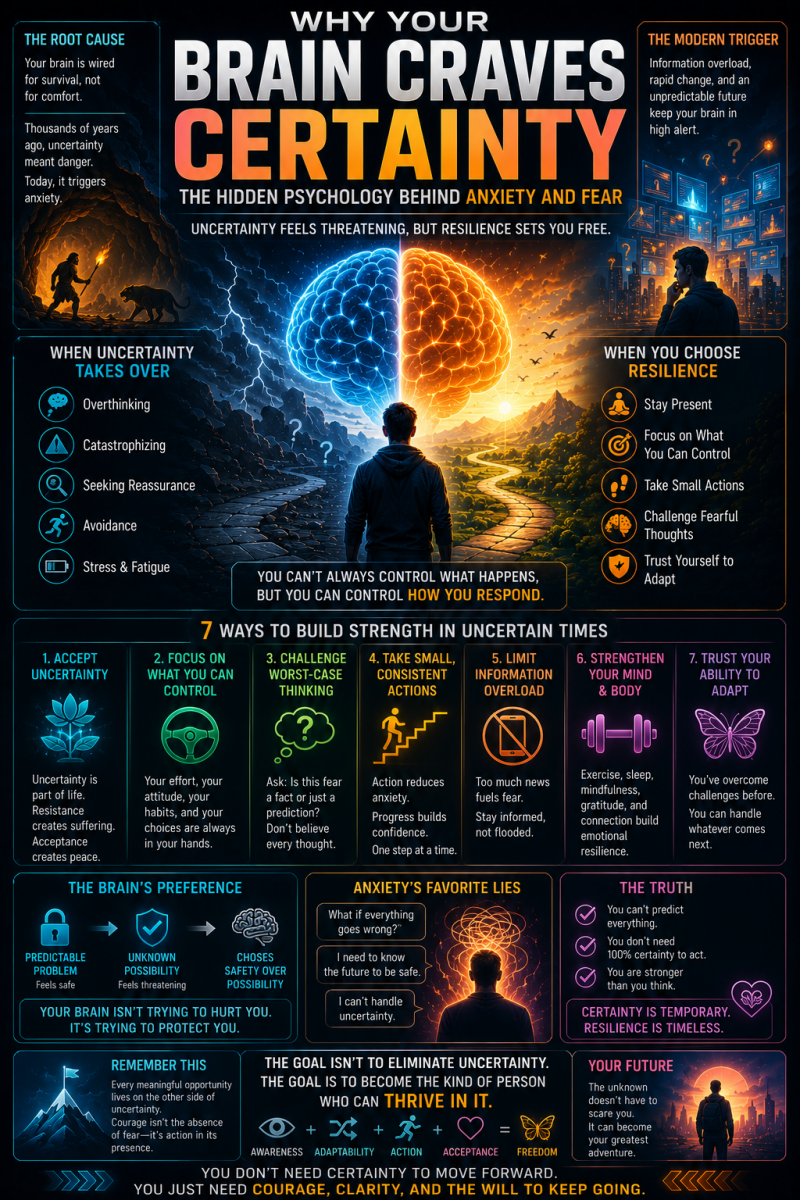
Your brain evolved for survival.
Thousands of years ago, uncertainty often meant danger.
If early humans weren't sure whether something moving in the bushes was a predator...
Assuming the worst increases survival.
That cautious wiring remains today.
The problem?
Modern uncertainty usually involves:
- emails
- finances
- relationships
- career decisions
- plans
not saber-toothed tigers.
Yet your brain often reacts as if both situations are equally threatening.
Important Truth
The brain prefers a predictable problem over an unpredictable possibility.
Even when the possibility might be harmless.
The Psychology of Fear of the Unknown
Psychologists call this:
Intolerance of Uncertainty
This refers to the tendency to feel significant distress when outcomes are unclear.
People experiencing uncertainty often find themselves asking:
- What if I fail?
- What if something goes wrong?
- What if I make the wrong choice?
- What if things never improve?
The questions themselves are not the problem.
The problem is becoming trapped inside them.
Why Anxiety Loves Uncertainty
Anxiety and uncertainty are close friends.
When the future feels unclear, anxiety steps in and says:
"Allow me to create several hundred possible disasters for your consideration."
Humor Break
An anxious brain at 2 a.m. is basically a highly imaginative movie director with unlimited funding 😄
The Brain's Need for Control
Humans naturally seek control because control creates safety.
When life feels predictable, the nervous system relaxes.
When life feels unpredictable, the brain becomes hyper-alert.
This activates the body's stress response.
Common reactions include:
- overthinking
- excessive planning
- avoidance
- procrastination
- worry
- mental fatigue
Ironically, many of these responses make us feel worse.
Why Modern Life Feels More Uncertain Than Ever
Today's world changes rapidly.
Technology evolves constantly.
Industries transform.
Economies fluctuate.
News cycles never stop.
Artificial intelligence is reshaping careers.
Social media exposes us to endless comparison and information overload.
Result:
Many people feel like they're standing on moving ground.
The future feels harder to predict than ever before.
And that uncertainty creates stress.
The Illusion of Certainty
Here's something surprising:
Absolute certainty has never existed.
Not for anyone.
Not at any point in history.
People often imagine previous generations had life figured out.
They didn't.
They simply faced different uncertainties.
Reality:
Nobody knows exactly:
- what next year will bring
- What opportunities will appear
- What challenges may emerge
Life has always involved uncertainty.
The difference is how we respond to it.
Why We Catastrophize
When faced with uncertainty, the brain often jumps to negative conclusions.
This process is known as:
Catastrophizing
The tendency to imagine the worst possible outcome.
Example:
Small symptom:
"I have a headache."
Brain:
"This is clearly the end."
😄
Catastrophizing creates unnecessary suffering because the mind treats imagined problems as if they are real.
The Hidden Cost of Seeking Constant Certainty
Many people spend enormous energy trying to eliminate uncertainty.
They:
- over-research
- seek endless reassurance
- avoid decisions
- delay action
- wait for perfect clarity
The problem?
Perfect certainty never arrives.
Truth
Waiting for certainty often creates more anxiety than taking action.
The Link Between Uncertainty and Growth
Here's the paradox.
Everything meaningful in life involves uncertainty.
Examples:
- starting a business
- changing careers
- falling in love
- investing
- learning new skills
- moving to a new place
Growth and uncertainty travel together.
You cannot eliminate one without limiting the other.
The Courage Myth
Many people believe courageous individuals don't feel fear.
False.
They feel fear.
They simply act despite it.
Courage is not certainty.
Courage is movement without certainty.
Important Reminder
Confidence comes after action, not before it.
How to Become Stronger During Uncertain Times
Let's move from understanding to practical action.
Step 1: Focus on What You Can Control
You cannot control:
- the economy
- global events
- other people's opinions
- unexpected challenges
You can control:
- your effort
- your attitude
- your habits
- your preparation
- your response
Rule:
Spend less energy worrying about what you can't influence.
Spend more energy improving what you can.
Step 2: Challenge Worst-Case Thinking
Ask yourself:
Is this fear a fact or a prediction?
Most anxious thoughts are predictions.
Not evidence.
This simple distinction creates psychological distance.
Step 3: Limit Information Overload
Constant exposure to news and social media increases uncertainty stress.
Stay informed.
But avoid becoming emotionally flooded.
Humor Break
Checking breaking news every six minutes will not improve your ability to influence global events 😄
Step 4: Build Psychological Flexibility
Resilient people don't expect life to go perfectly.
They trust their ability to adapt.
This mindset changes everything.
Instead of:
"What if things go wrong?"
Ask:
"What if I can handle whatever happens?"
Step 5: Take Small Actions
Action reduces anxiety.
Waiting increases it.
Examples:
- make the phone call
- send the application
- start the project
- begin learning the skill
Movement creates momentum.
Step 6: Strengthen Your Emotional Resilience
Resilience grows through:
- exercise
- quality sleep
- strong relationships
- mindfulness
- gratitude
- healthy routines
A stronger mind handles uncertainty better.
Step 7: Accept That Uncertainty Is Part of Life
This may be the most powerful lesson of all.
The goal is not to eliminate uncertainty.
The goal is to become comfortable with it.
Important Truth
Peace comes not from controlling the future but from trusting yourself within it.
The Opportunity Hidden Inside Uncertainty
Every major opportunity once looked uncertain.
Every breakthrough.
Every promotion.
Every business success.
Every meaningful relationship.
At some point, they all involved risk.
Uncertainty isn't only where fear lives.
It's also where possibility lives.
The Resilience Formula
If you remember nothing else:
Awareness + Adaptability + Action + Acceptance = Emotional Strength
These qualities help you navigate uncertainty without being controlled by it.
The Mature Perspective on Fear
As we grow older, we often realize something profound:
Life is not about eliminating uncertainty.
It's about becoming the kind of person who can handle it.
Because certainty is temporary.
Change is constant.
And resilience is priceless.
Conclusion: The Future Doesn't Need to Be Certain
Your brain naturally craves certainty.
That's normal.
It's how humans are wired.
But certainty is not required for progress.
It is not required for happiness.
And it is not required for courage.
Final Truth
You don't need to know exactly what will happen next.
You only need enough confidence to take the next step.
Because the strongest people are not those who predict the future perfectly.
They are those who learn how to thrive even when the future remains unknown.
And that ability may be one of the most valuable skills you will ever develop.
Add comment
Comments