Introduction: Should You Be Worried About AI Taking Your Job?
Let's address the elephant-sized robot in the room.
Artificial Intelligence is everywhere.
It's writing emails.
Creating images.
Analyzing data.
Answering customer questions.
Generating code.
Even helping people decide what to watch, buy, eat, and sometimes who to date.
Naturally, many workers are asking:
"Will AI replace me?"
It's a fair question.
Headlines often make it sound like robots are moments away from taking over every office, factory, and coffee shop on Earth.
But the reality is far more nuanced.
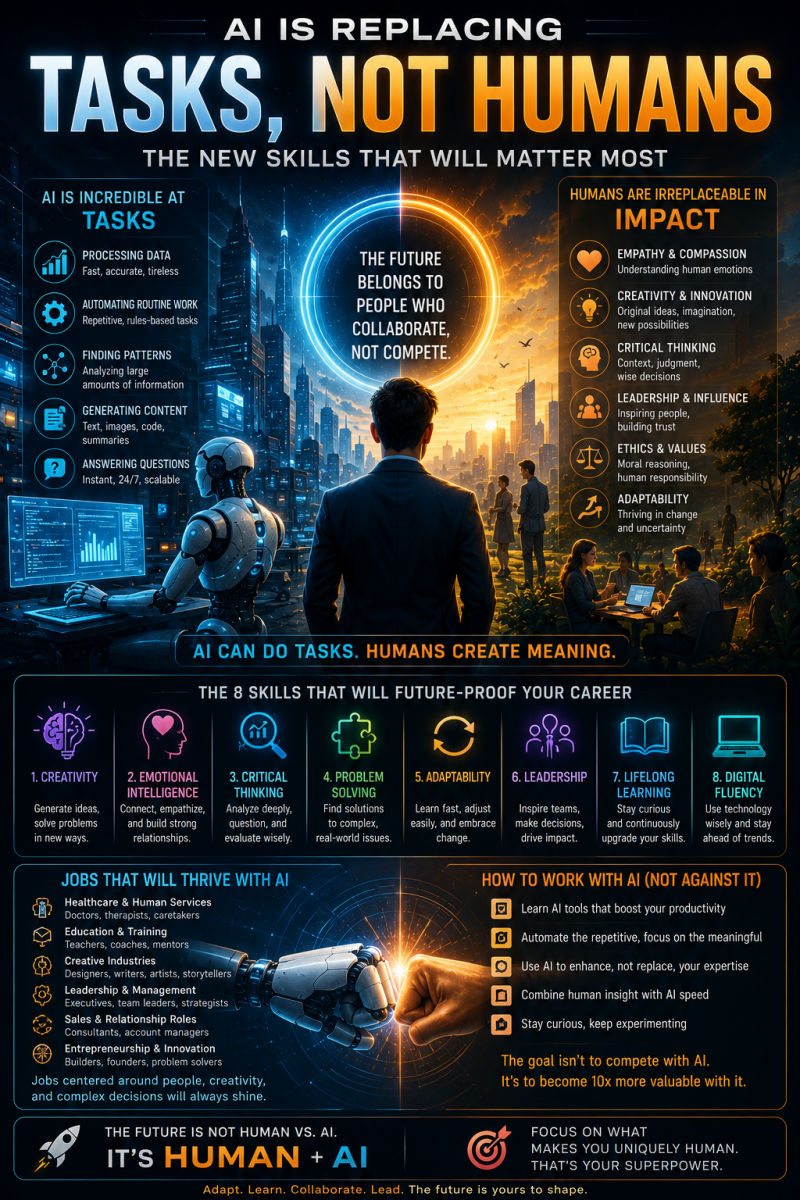
The future isn't about humans versus AI.
It's about humans with AI versus humans without AI.
The biggest shift isn't that AI is replacing people.
It's that AI is replacing certain tasks.
And that distinction changes everything.
The Great AI Misunderstanding
When people hear:
"AI can do this job."
They often assume:
"That means humans are no longer needed."
But most jobs are actually collections of many different tasks.
For example, a marketing manager doesn't simply:
- write content
They also:
- understand customers
- build relationships
- create strategy
- solve problems
- negotiate
- make decisions
- lead teams
AI can help with some of those activities.
But it cannot fully replace the human being performing all of them.
Important Truth
AI automates tasks. Humans create meaning.
What AI Does Extremely Well
Let's be honest.
AI is remarkably good at certain things.
It can:
- process huge amounts of data
- identify patterns
- summarize information
- automate repetitive work
- generate first drafts
- perform calculations quickly
- answer routine questions
These capabilities are transforming industries.
Humor Break
AI can write a meeting summary in seconds.
Unfortunately, it still can't explain why that meeting could have been an email 😄
What AI Still Struggles With
Despite impressive progress, AI has significant limitations.
It struggles with:
- emotional understanding
- human relationships
- ethical judgment
- leadership
- creativity with real-world context
- empathy
- trust-building
- cultural nuance
These areas remain deeply human.
And they will become increasingly valuable.
Why AI Creates Opportunity, Not Just Disruption
Every major technological revolution caused fear.
People worried about:
- automobiles replacing jobs
- computers replacing workers
- The internet eliminating careers
Yet history shows something interesting.
Technology changes jobs.
It rarely eliminates the need for human contribution.
Instead, new opportunities emerge.
The challenge is adaptation.
The New Career Reality
The future workforce will not be divided into:
- people who use AI
- people who don't use AI
It will be divided into:
- people who adapt
- people who resist adaptation
The winners won't necessarily be the smartest.
They'll be the most adaptable.
Skill #1: Creativity
As AI becomes more capable of producing content, creativity becomes more valuable.
Why?
Because creativity is not simply generating information.
It's combining ideas in original ways.
It's imagining possibilities.
It's seeing opportunities others miss.
Creative professionals can:
- innovate
- design solutions
- build brands
- tell stories
- develop products
AI can assist creativity.
But human imagination remains the source.
Truth
The future belongs to people who can think beyond the obvious.
Skill #2: Emotional Intelligence
Emotional intelligence may become one of the most valuable skills of the AI era.
This includes:
- empathy
- communication
- self-awareness
- relationship management
- emotional regulation
Businesses run on relationships.
Customers trust people.
Teams follow leaders.
Employees seek understanding.
These are profoundly human experiences.
Example
An AI may answer customer questions.
A human creates customer loyalty.
Skill #3: Critical Thinking
AI generates answers.
Humans must evaluate them.
This distinction is crucial.
Future workers will need to:
- verify information
- question assumptions
- identify errors
- make informed judgments
Important Reminder
Just because AI says something confidently doesn't make it correct.
Some people have learned that the hard way 😄
Skill #4: Problem Solving
Organizations don't pay people simply for knowledge.
They pay them for solutions.
Problem-solving involves:
- analyzing situations
- identifying causes
- evaluating options
- making decisions
These skills remain highly valuable.
Especially when situations are complex and unpredictable.
Skill #5: Adaptability
This may be the most important skill of all.
The future will change rapidly.
New technologies will emerge.
Industries will evolve.
Career paths will shift.
Successful people will be those who can:
- learn quickly
- adjust effectively
- remain flexible
- embrace change
Truth
Adaptability is the new job security.
Skill #6: Leadership
Leadership extends far beyond management.
It includes:
- inspiring others
- making decisions
- resolving conflict
- building culture
- guiding teams
AI can provide information.
It cannot replace authentic leadership.
People follow people.
Not algorithms.
Skill #7: Lifelong Learning
The traditional career model assumed:
Learn once.
Work for decades.
Retire.
That model is disappearing.
Today's professionals must become continuous learners.
Learn regularly:
- new technologies
- communication skills
- industry trends
- digital tools
- emerging opportunities
Learning is no longer optional.
It's survival.
Skill #8: Personal Branding
As automation increases, uniqueness becomes valuable.
Your personal brand includes:
- expertise
- reputation
- communication style
- credibility
- trustworthiness
People do business with individuals they know and trust.
That won't change.
Example
Thousands may use AI tools.
But nobody can duplicate your personal experience and perspective.
The Careers Most Likely to Thrive
While AI will affect nearly every industry, careers involving human interaction remain strong.
Examples include:
- leadership roles
- consulting
- coaching
- healthcare
- education
- entrepreneurship
- sales
- relationship management
- creative industries
These professions combine knowledge with human connection.
The AI Partnership Mindset
The smartest professionals are not competing against AI.
They're collaborating with it.
They ask:
"How can AI help me work smarter?"
Instead of:
"How do I stop AI from changing things?"
The second question creates fear.
The first creates opportunity.
How to Future-Proof Your Career Starting Today
You don't need to become an AI expert overnight.
Start with practical steps:
Learn AI tools relevant to your industry
Improve communication skills
Strengthen emotional intelligence
Develop leadership abilities
Practice problem-solving
Build your network
Stay curious
Continue learning
Small improvements compound over time.
Humor Break
Don't panic if AI learns how to write reports.
Many people still struggle to read them 😄
The Mature Perspective on AI
Every generation faces disruptive change.
The challenge isn't avoiding it.
It's adapting to it.
The most successful people aren't those who resist the future.
They're those who prepare for it.
Technology will continue evolving.
But human qualities remain timeless.
The Future-Proof Formula
If you remember nothing else:
Creativity + Emotional Intelligence + Adaptability + Problem Solving + Lifelong Learning = Career Resilience
These skills become more valuable—not less—as AI advances.
Conclusion: The Future Still Needs Humans
Artificial Intelligence will transform how we work.
There is no question about that.
Some tasks will disappear.
Others will become automated.
Entire industries will evolve.
But the future is not a story about humans becoming obsolete.
It's a story about humans becoming more valuable where they matter most.
Final Truth
The workers who thrive in the AI era won't be those who know the most. They will be those who learn the fastest, adapt the quickest, and bring uniquely human value to every situation.
So instead of asking:
"Will AI replace me?"
Ask:
"What human strengths can I develop that technology cannot replicate?"
Because that answer may determine your success in the decades ahead.
And fortunately...
Being human is still a tremendous competitive advantage.
Add comment
Comments