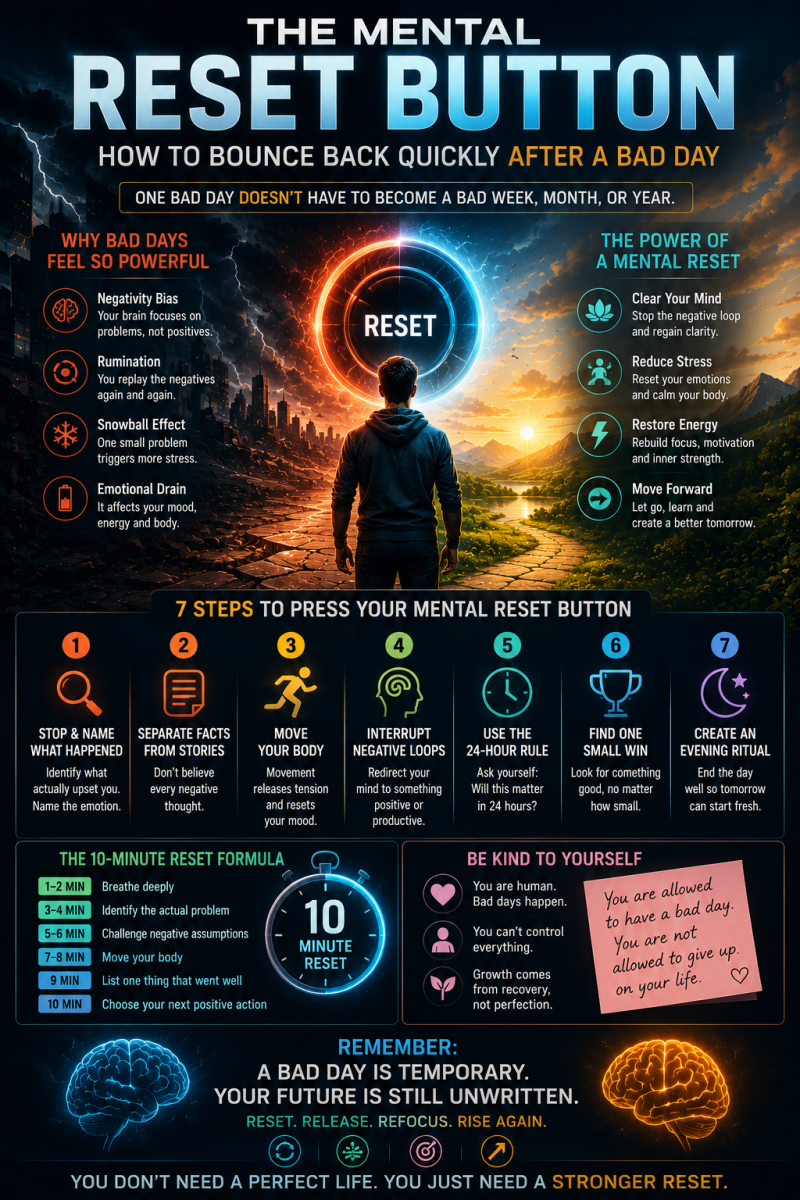
Introduction: We've All Had That Day
You know the one.
The alarm didn't go off.
Coffee spilled on your shirt.
Traffic was terrible.
Your inbox looked like it had multiplied overnight.
Someone sent an email that instantly raised your blood pressure.
Then, just when you thought things couldn't get worse, your phone battery died at 4%.
At that point, you're not even having a bad day anymore.
You're starring in your own disaster movie.
The problem isn't that bad days happen.
They happen to everyone.
The real problem is when a bad day follows us home, invades tomorrow, and rents space in our minds long after the actual events are over.
The good news?
Your brain has a reset button.
You simply need to know how to find it.
Why Bad Days Feel So Powerful
A bad day can feel overwhelming because the brain naturally gives more attention to negative experiences than positive ones.
Psychologists call this:
Negativity Bias
Our ancestors survived by paying close attention to danger and problems.
As a result, modern humans still tend to:
- remember criticism longer than compliments
- focus on mistakes more than successes
- replay negative events repeatedly
One unpleasant interaction can overshadow ten positive ones.
Your brain isn't broken.
It's doing exactly what it evolved to do.
Unfortunately, it wasn't designed for traffic jams, social media arguments, and office politics.
The Snowball Effect of a Bad Day
One bad event often creates additional bad emotions.
For example:
Your boss criticizes your work.
↓
You become frustrated.
↓
You lose focus.
↓
You make another mistake.
↓
You become more frustrated.
↓
You go home irritated.
↓
You snap at your spouse.
↓
Now everyone is unhappy.
The original problem may have lasted five minutes.
The emotional consequences can last all day.
Important Truth
A bad moment is not the same thing as a bad day.
Most people accidentally turn temporary problems into permanent emotional residents.
Why We Struggle to Let Go
The brain hates unfinished business.
When something bothers you, your mind keeps returning to it.
This is called:
Rumination
The mental equivalent of replaying the same movie scene repeatedly, hoping for a different ending.
Humor Break
Rumination is basically your brain saying:
"Let's revisit that embarrassing thing you said in 2017."
"Again?"
"Yes. For educational purposes." 😄
The Hidden Cost of Carrying a Bad Day
When you refuse to mentally reset, you pay a price.
Emotionally
- irritability
- anxiety
- frustration
- sadness
Mentally
- poor concentration
- reduced creativity
- overthinking
Physically
- fatigue
- muscle tension
- headaches
- poor sleep
A bad day affects far more than your mood.
It affects your entire system.
The Mental Reset Strategy
Let's talk about practical recovery.
Step 1: Stop and Name What Happened
Many people never pause long enough to identify what's actually bothering them.
Ask yourself:
What specifically upset me?
Was it:
- rejection?
- disappointment?
- embarrassment?
- stress?
- exhaustion?
Naming emotions reduces their intensity.
Example
Instead of:
"I'm miserable."
Try:
"I'm frustrated because that meeting went badly."
Specific emotions are easier to manage than vague distress.
Step 2: Separate Facts from Stories
Your brain loves creating dramatic stories.
Fact:
Your presentation didn't go well.
Story:
"My career is over."
Fact:
Someone ignored your text.
Story:
"They hate me."
Fact:
You made a mistake.
Story:
"I'm a failure."
Truth
Most suffering comes from the story, not the event.
Step 3: Move Your Body
Your brain and body are connected.
Stress creates physical tension.
Movement helps release it.
Effective options:
- walking
- stretching
- exercising
- dancing
- gardening
Anything that gets you moving.
Humor Break
Never underestimate the therapeutic power of aggressively vacuuming while pretending you're in a music video 😄
Step 4: Interrupt Negative Thought Loops
Bad days often become bad weeks because people repeatedly replay them.
When you catch yourself ruminating:
Ask:
"Is this helping me?"
If not, redirect attention.
Focus on:
- a task
- a hobby
- reading
- conversation
- exercise
Mental redirection is not avoidance.
It's recovery.
Step 5: Practice the 24-Hour Perspective
Ask yourself:
Will this matter in:
- 24 hours?
- 24 days?
- 24 months?
Many problems shrink dramatically under this lens.
Example
That awkward comment during the meeting?
Most people forgot it before lunch.
You may be the only person still thinking about it.
Step 6: Look for One Small Win
Bad days create tunnel vision.
You focus only on what went wrong.
Break the pattern by identifying:
One thing that went right.
Perhaps:
- You finished a task
- helped someone
- learned something
- exercised
- remained calm
Small wins matter.
Step 7: Create an Evening Reset Ritual
Highly resilient people don't carry every day into tomorrow.
They deliberately reset.
Examples:
- taking a walk
- journaling
- prayer or meditation
- reading
- gratitude reflection
- listening to calming music
The goal is simple:
Signal to your brain that today is finished.
The Power of Self-Compassion
Many people recover slowly because they become their own harshest critic.
After a mistake, they think:
- "I'm useless."
- "I always mess up."
- "I should know better."
Imagine speaking to a friend that way.
You wouldn't.
Offer yourself the same kindness.
Important Reminder
You can have a bad day without being a bad person.
What Highly Resilient People Do Differently
Resilient people are not immune to stress.
They recover faster.
They:
- accept setbacks
- adapt quickly
- maintain perspective
- avoid catastrophizing
- keep moving forward
Their secret isn't perfection.
It's recovery.
The 10-Minute Mental Reset Formula
When everything feels overwhelming:
Minute 1–2:
Breathe deeply.
Minute 3–4:
Identify the actual problem.
Minute 5–6:
Challenge negative assumptions.
Minute 7–8:
Move your body.
Minute 9:
List one thing that went well.
Minute 10:
Choose your next positive action.
Simple.
Powerful.
Effective.
The Mature Perspective on Bad Days
As we grow older, we learn something important:
Life is not ruined by bad days.
It's shaped by how we respond to them.
Everyone experiences setbacks.
Everyone gets frustrated.
Everyone occasionally wants to throw their phone into the nearest lake.
The difference is recovery.
Final Thoughts: Tomorrow Doesn't Have to Pay for Today
A bad day is just that:
A bad day.
Not a bad life.
Not a bad future.
Not a bad identity.
Final Truth
Your ability to recover is more important than your ability to avoid problems.
Because setbacks are inevitable.
But staying stuck is optional.
So tonight, take a breath.
Release what you cannot change.
Learn what you can.
And permit yourself to start fresh tomorrow.
Because one difficult day should never have the power to define your story.
Your reset button is still there.
Press it. 🚀
Add comment
Comments