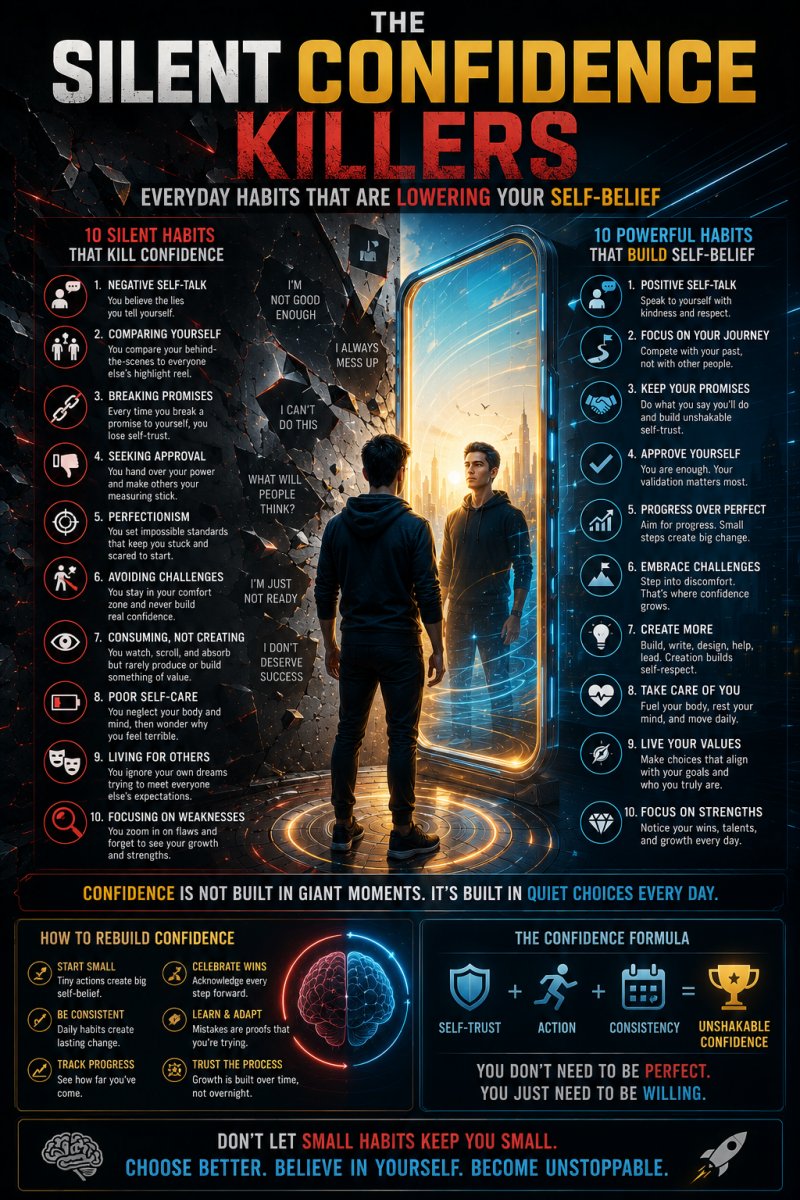
Introduction: Confidence Rarely Disappears Overnight
Most people assume confidence is lost through major failures.
A failed business.
A painful breakup.
A public embarrassment.
While those experiences can certainly affect confidence, the truth is often much less dramatic.
Confidence usually doesn't collapse overnight.
It leaks.
Slowly.
Quietly.
Through small daily habits that seem harmless on the surface but gradually undermine how you see yourself.
The most dangerous confidence killers aren't obvious.
They're hidden in everyday routines, thoughts, and behaviors that many people repeat without realizing the damage they cause.
The good news?
If habits can destroy confidence, habits can also rebuild it.
What Confidence Really Is
Before we begin, let's clear up a common misunderstanding.
Confidence is not:
- arrogance
- perfection
- always feeling fearless
- believing you're better than others
True confidence is much simpler.
Confidence is trust in yourself.
It is the belief that:
"No matter what happens, I can handle it."
Confident people still experience fear.
They don't allow fear to make all their decisions.
The Silent Confidence Killers
Let's uncover the everyday habits that quietly weaken self-belief.
1. Constant Negative Self-Talk
The voice inside your head matters.
More than most people realize.
Examples:
- "I'm not smart enough."
- "I'll probably fail."
- "I always mess things up."
- "I'm not good at this."
Your brain listens to what you repeatedly tell it.
Over time, these thoughts become beliefs.
And beliefs become identity.
Humor Break
Imagine having a friend who followed you around all day, saying:
"You're terrible."
"You'll fail."
"Don't even try."
You'd stop talking to them.
Yet many people allow that voice inside their own head every day 😄
2. Comparing Yourself to Everyone Else
Comparison is one of confidence's greatest enemies.
Social media has made this worse than ever.
You compare:
- you're beginning to someone's middle
- your reality to someone's highlight reel
- your struggles to someone else's victories
Truth:
You are seeing edited success stories.
Not complete lives.
Important Reminder
Comparison makes you focus on what you lack instead of what you've achieved.
3. Breaking Promises to Yourself
This is one of the most overlooked confidence killers.
Every time you say:
- "I'll start tomorrow."
- "I'll exercise tonight."
- "I'll finish that project."
and then don't follow through...
Your brain learns something.
It learns:
"I can't trust myself."
Self-confidence grows when self-trust grows.
4. Seeking Constant Approval
Many people accidentally hand over control of their confidence.
Their self-worth depends on:
- likes
- compliments
- praise
- validation
The problem?
External approval is unreliable.
Reality:
People's opinions change constantly.
Your confidence shouldn't rise and fall with them.
5. Perfectionism
Perfectionism often disguises itself as high standards.
But underneath, it creates fear.
Perfectionists think:
"If I can't do it perfectly, why try?"
The result?
- procrastination
- hesitation
- self-doubt
Truth:
Progress builds confidence.
Perfection builds anxiety.
6. Avoiding Challenges
Confidence grows through evidence.
You gain confidence by doing difficult things and surviving them.
Avoidance prevents that evidence from forming.
Example:
Every challenge avoided sends the message:
"This is too much for me."
Every challenge faced sends the message:
"I can handle more than I thought."
7. Constantly Consuming, Rarely Creating
Many people spend hours:
- scrolling
- watching
- consuming content
But very little time:
- creating
- building
- producing
Consumption often creates comparison.
Creation builds confidence.
Humor Break
After watching motivational videos for three hours...
You haven't actually become motivated.
You've become a professional spectator 😄
8. Poor Physical Self-Care
Your mind and body are connected.
Confidence suffers when:
- sleep is poor
- energy is low
- Nutrition is neglected
- movement disappears
You don't need perfection.
But your body influences your emotional state more than you realize.
9. Living According to Other People's Expectations
Many adults quietly lose confidence because they spend years trying to become who others want them to be.
Parents.
Friends.
Society.
Social media.
Coworkers.
Important Question:
Are you living your life...
Or performing for an audience?
Authenticity strengthens confidence.
Pretending weakens it.
10. Focusing Only on Weaknesses
Many people constantly analyze:
- flaws
- mistakes
- shortcomings
But rarely acknowledge:
- strengths
- growth
- achievements
This creates a distorted self-image.
Truth:
You are not only your weaknesses.
You are also your strengths.
The Psychology of Self-Belief
Confidence grows from evidence.
Not wishful thinking.
Every positive action creates proof.
Evidence Examples:
- keeping a promise
- learning a skill
- solving a problem
- overcoming discomfort
- finishing something difficult
The more evidence you collect, the stronger your self-belief becomes.
How to Rebuild Confidence
Let's move from problem to solution.
Step 1: Keep Small Promises
Start tiny.
Examples:
- make your bed
- take a walk
- read 10 pages
- drink more water
Small promises build trust.
Trust builds confidence.
Step 2: Talk to Yourself Better
You don't need fake positivity.
You need realistic encouragement.
Instead of:
"I can't do this."
Try:
"This is challenging, but I can learn."
Step 3: Stop Measuring Yourself Against Others
Measure progress against:
Yesterday's version of yourself.
Not someone else's journey.
Step 4: Do Difficult Things Regularly
Confidence grows when you repeatedly prove:
"I can handle discomfort."
Examples:
- speaking up
- learning new skills
- exercising
- tackling difficult conversations
Step 5: Celebrate Progress
Most people only celebrate outcomes.
Celebrate effort, too.
Progress deserves recognition.
Humor Break
If your plant grows one leaf...
You celebrate it.
Maybe treat your own growth with the same enthusiasm 😄
Step 6: Create More Than You Consume
Build something.
Write something.
Learn something.
Share something.
Create evidence of capability.
The Confidence Formula
If you remember nothing else:
Confidence = Self-Trust + Action + Consistency
Not perfection.
Not popularity.
No approval.
Just repeated evidence that you can rely on yourself.
The Mature Perspective on Confidence
As people grow older, many realize something important:
The most confident people are not the loudest.
They are not always the most talented.
They are not necessarily the most successful.
They simply know who they are.
They trust themselves.
And they no longer need constant permission from others to believe in their own value.
Conclusion: Confidence Is Built Daily
Confidence isn't a gift some people receive, and others don't.
It's a skill.
A habit.
A relationship with yourself.
And like every relationship, it grows through trust.
Final Truth
Every promise you keep, every challenge you face, and every small step you take is casting a vote for the person you are becoming.
Choose enough of those votes consistently...
and confidence becomes inevitable.
Because self-belief isn't built in giant moments.
It's built in the quiet choices you make every single day.
Add comment
Comments