Introduction: When Was the Last Time You Were Truly Bored?
Be honest.
When was the last time you?
- sat quietly without your phone
- waited in silence
- stared out the window
- allowed your mind to wander naturally
For most people, the answer is:
“Honestly… I can’t remember.”
Modern life has almost eliminated boredom.
Every empty moment gets filled instantly with:
- scrolling
- videos
- messages
- podcasts
- notifications
- endless digital stimulation
And while that may feel entertaining…
It’s quietly exhausting your brain.
The Modern Fear of Empty Time
Today, boredom is treated like a problem that must be eliminated immediately.
Waiting in line? → Check phone.
Five free minutes? → Open social media.
Silence? → put on something in the background.
Your brain rarely gets a chance to simply exist without stimulation.
Humor Break:
Some people are so uncomfortable with silence…
They watch videos while brushing their teeth 😄
What Is Boredom (Psychologically)?
Boredom is not simply “having nothing to do.”
Psychologists describe boredom as:
A mental state where external stimulation is low and the brain begins searching inward for engagement.
And surprisingly…
That inward search is where many powerful mental benefits begin.
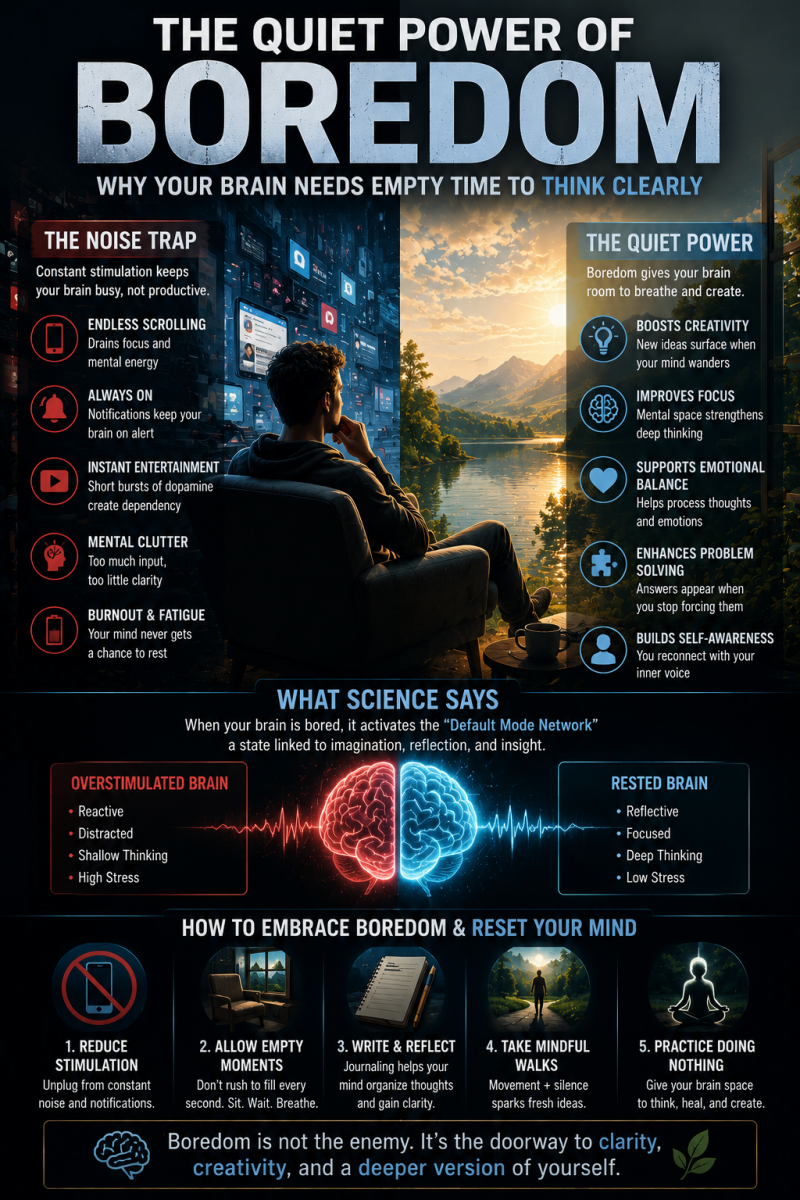
Why Your Brain Actually Needs Boredom
Your brain was designed for cycles:
- stimulation
- rest
- focus
- reflection
But modern life provides nonstop stimulation without enough recovery.
Result:
Your mind becomes:
- mentally cluttered
- distracted
- overstimulated
- creatively blocked
The Creativity Connection
Research increasingly shows that boredom supports:
- creativity
- problem solving
- self-reflection
- imagination
Why?
Because when external input decreases, the brain starts generating internal thoughts more freely.
Important insight:
Some of your best ideas appear when your brain is not overloaded.
Why Great Ideas Often Happen in the Shower
Ever notice how random breakthroughs happen during:
- showers
- walks
- driving
- quiet moments
That’s not accidental.
During low-stimulation activities, your brain shifts into what scientists call:
“Default Mode Network” activity.
This is when the brain begins:
- connecting ideas
- processing emotions
- generating insights
Translation:
Your brain starts doing deeper thinking when it finally gets space.
The Constant Stimulation Problem
Modern technology trains your brain to expect constant novelty.
Every scroll gives:
- new information
- new entertainment
- new dopamine
Over time, this weakens your tolerance for stillness.
Result:
Silence starts feeling uncomfortable.
Boredom feels unbearable.
Focus becomes harder.
Humor Break:
Some people open Instagram, TikTok, YouTube, and Netflix at the same time…
Then wonder why their brain feels like scrambled eggs 😄
Why Constant Entertainment Blocks Deep Thinking
Deep thinking requires mental space.
But if your attention is constantly occupied, your brain stays in reactive mode.
You consume…
But rarely reflect.
Important truth:
A distracted mind struggles to think deeply.
The Hidden Benefits of Boredom
Let’s talk about what boredom quietly improves.
1. Creativity
Boredom encourages imagination.
Without constant input, your mind starts creating ideas naturally.
2. Emotional Processing
Quiet moments help the brain process emotions and experiences.
Without reflection, emotional stress accumulates.
3. Problem Solving
Many solutions emerge when the brain relaxes.
That’s why forcing answers often works less effectively than stepping away briefly.
4. Mental Recovery
Your brain needs breaks from constant stimulation.
Boredom can act like mental recovery time.
5. Self-Awareness
When distractions disappear, you reconnect with your own thoughts.
That can feel uncomfortable…
But also deeply clarifying.
Why People Avoid Boredom
Because boredom exposes what distraction hides.
Without constant stimulation, people may suddenly notice:
- stress
- loneliness
- uncertainty
- dissatisfaction
So they return to noise.
Truth:
Sometimes distraction is not entertainment.
It’s avoidance.
The “Always-On” Lifestyle Is Mentally Draining
Many adults never fully disconnect anymore.
Even during rest, the brain continues consuming information.
Example:
You finish work…
Then immediately:
- scroll social media
- binge content
- answer messages
- watch videos
Your body rests.
Your mind doesn’t.
How to Rebuild Your Brain’s Tolerance for Quiet
The goal is not to become anti-technology.
It’s to restore balance.
Step 1: Stop Filling Every Empty Moment
This is powerful.
Allow small moments of silence to exist.
Example:
- wait without checking your phone
- drive without constant audio
- walk without stimulation sometimes
Step 2: Schedule Quiet Time
Treat mental quietness as intentional recovery.
Try:
- journaling
- reflection walks
- silent mornings
- screen-free evenings
Step 3: Reduce Overstimulation
Your brain needs fewer inputs—not more.
Reduce:
- endless scrolling
- constant notifications
- multitasking overload
Step 4: Practice Single-Tasking
Focus deeply on one thing at a time.
Your brain calms when attention stops fragmenting.
Step 5: Let Your Mind Wander Naturally
Not every second needs productivity.
Sometimes mental wandering creates unexpected clarity.
Humor Break:
Your best life idea might arrive…
The moment you stop checking your phone every 11 seconds 😄
The Mature Perspective: Stillness Is a Superpower
In a world addicted to noise, stillness becomes powerful.
People who can:
- sit quietly
- think clearly
- reflect deeply
- tolerate boredom
Often develop stronger creativity, focus, and emotional balance.
The Boredom Formula
If you remember nothing else:
- reduce constant stimulation
- allow empty moments
- embrace quietness
- give your brain recovery time
- trust the power of mental space
Conclusion: You’re Brain Needs Less Noise to Think Better
Modern culture teaches people to fear boredom.
But boredom is not the enemy.
Sometimes it’s the doorway to:
- creativity
- clarity
- healing
- deeper thinking
Final Truth:
Your brain does not always need more entertainment.
Sometimes it needs more space.
So the next time you feel the urge to instantly fill every quiet moment with stimulation…
Pause.
Let your mind breathe.
Because in those silent moments—
Your brain may finally have room to think clearly again.
Add comment
Comments