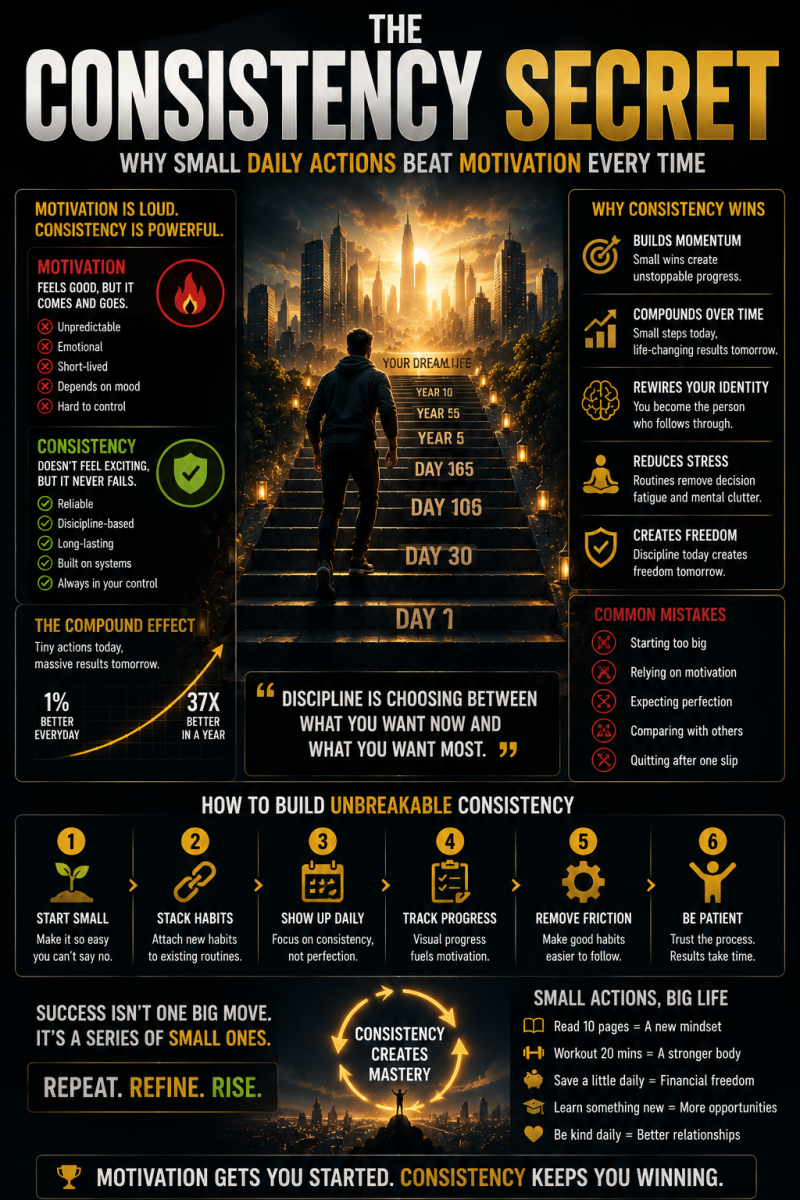
Introduction: The Real Secret Behind Successful People
Most people think success comes from:
- massive talent
- huge opportunities
- powerful motivation
- dramatic breakthroughs
But when you study highly successful people closely, you often discover something less exciting…
And far more powerful.
Consistency.
Not flashy motivation.
Not an overnight transformation.
Not magical inspiration.
Just repeated daily action.
Truth:
Small actions, repeated consistently, will outperform occasional bursts of motivation almost every time.
And honestly?
That’s both comforting and slightly annoying 😄
Because it means success is less about waiting for the perfect mood…
And more about showing up repeatedly.
Why Motivation Feels Powerful—but Fails Long-Term
Motivation is emotional energy.
And emotions are unstable.
Some days you feel unstoppable.
On other days, your brain acts like replying to one email deserves a vacation.
Motivation is excellent for:
- starting
- excitement
- short-term action
But terrible for:
- long-term consistency
- discipline
- sustained growth
The Psychology of Consistency
Your brain changes through repetition.
Not intensity.
Every repeated behavior strengthens mental pathways.
This is why habits become automatic over time.
Important insight:
What you do occasionally shapes moments.
What you do consistently shapes your life.
Why Small Actions Matter More Than Big Bursts
Many people fail because they think success requires a giant effort immediately.
So they create impossible routines like:
- waking up at 4 AM
- exercising 2 hours daily
- reading 100 pages
- becoming spiritually enlightened before breakfast 😄
Then three days later?
Complete collapse.
The problem:
Big, unsustainable effort creates burnout.
Small sustainable action creates momentum.
The Compound Effect of Daily Habits
Consistency works like compound interest.
Tiny actions seem insignificant at first.
But over time?
The results become massive.
Example:
Reading 10 pages daily = multiple books yearly.
Walking 20 minutes daily = major long-term health improvement.
Writing one page daily = an entire book eventually.
Truth:
Little progress still moves you forward.
Why People Underestimate Consistency
Humans love dramatic results.
But consistency is quiet.
Boring, even.
No fireworks.
No movie soundtrack.
No motivational speech playing in the background.
Just repetition.
And yet…
Consistency quietly defeats:
- procrastination
- lack of motivation
- inconsistency
- overwhelm
The Identity Shift Behind Consistency
Consistent people stop asking:
“Do I feel like doing this?”
Instead, they think:
“This is simply what I do.”
That identity shift changes everything.
Why Daily Routines Reduce Mental Stress
Consistency creates structure.
Structure reduces chaos.
When habits become automatic, your brain uses less energy deciding what to do.
Example:
Without routines:
constant negotiation
With routines:
automatic behavior
Humor Break:
Undisciplined brain:
“Should we exercise today?”
Consistent brain:
“We already decided this three months ago.” 😄
The Biggest Consistency Mistakes
Let’s expose the common traps.
1. Starting Too Big
Most people fail because they overload themselves.
Solution:
Start smaller than your ego wants.
2. Depending on Motivation
Motivation fluctuates.
Systems create reliability.
3. Seeking Perfection
Missing one day is normal.
Quitting entirely is the danger.
Rule:
Never miss twice.
4. Comparing Your Progress to Others
Consistency is personal.
Someone else’s speed has nothing to do with your journey.
5. Ignoring Environment Design
Your environment either supports consistency—or destroys it.
Example:
Want to focus?
Don’t keep your phone beside you like an emotional support device 😄
How to Build Strong Consistency
Now let’s make this practical.
Step 1: Make Habits Extremely Small
Tiny habits reduce resistance.
Example:
Instead of:
“Workout 90 minutes.”
Start:
“10 minutes daily.”
Step 2: Attach Habits to Existing Routines
This is called “habit stacking.”
Example:
- read after morning coffee
- stretch after brushing teeth
- journal before bed
Your brain loves predictable patterns.
Step 3: Focus on Showing Up
In the beginning, consistency matters more than performance.
Important:
A small completed action beats a perfect plan that never happens.
Step 4: Track Progress Visually
Humans are motivated by visible progress.
Simple methods:
- calendar check marks
- habit trackers
- journals
Step 5: Remove Friction
Make good habits easier.
Example:
- prepare clothes beforehand
- simplify routines
- reduce distractions
Step 6: Build Systems, Not Emotional Dependence
Stop relying on “feeling inspired.”
Reliable systems outperform emotional motivation.
Why Consistency Builds Confidence
Every time you follow through, you strengthen self-trust.
You begin proving to yourself:
“I can rely on myself.”
That changes identity.
The Mature Perspective: Success Is Usually Repetition
As mature adults grow, they often realize:
Most meaningful success is not dramatic.
It is a repeated ordinary action over long periods of time.
Real growth often looks like:
- showing up tired
- doing small tasks consistently
- continuing without applause
- improving gradually
The Consistency Formula
If you remember nothing else:
- start small
- repeat daily
- reduce friction
- ignore perfection
- trust the process
Conclusion: Tiny Actions Create Massive Futures
The modern world loves instant results.
But real transformation usually happens quietly.
One habit.
One decision.
One repeated action at a time.
Final Truth:
You do not need to become extraordinary overnight.
You simply need to become slightly better—consistently.
Because in the end:
Motivation may start the journey.
But consistency is what actually changes your life.
So the next time you feel discouraged by slow progress, remember:
Small daily actions may look insignificant today…
But they are quietly building your future.
One repetition at a time.
Add comment
Comments