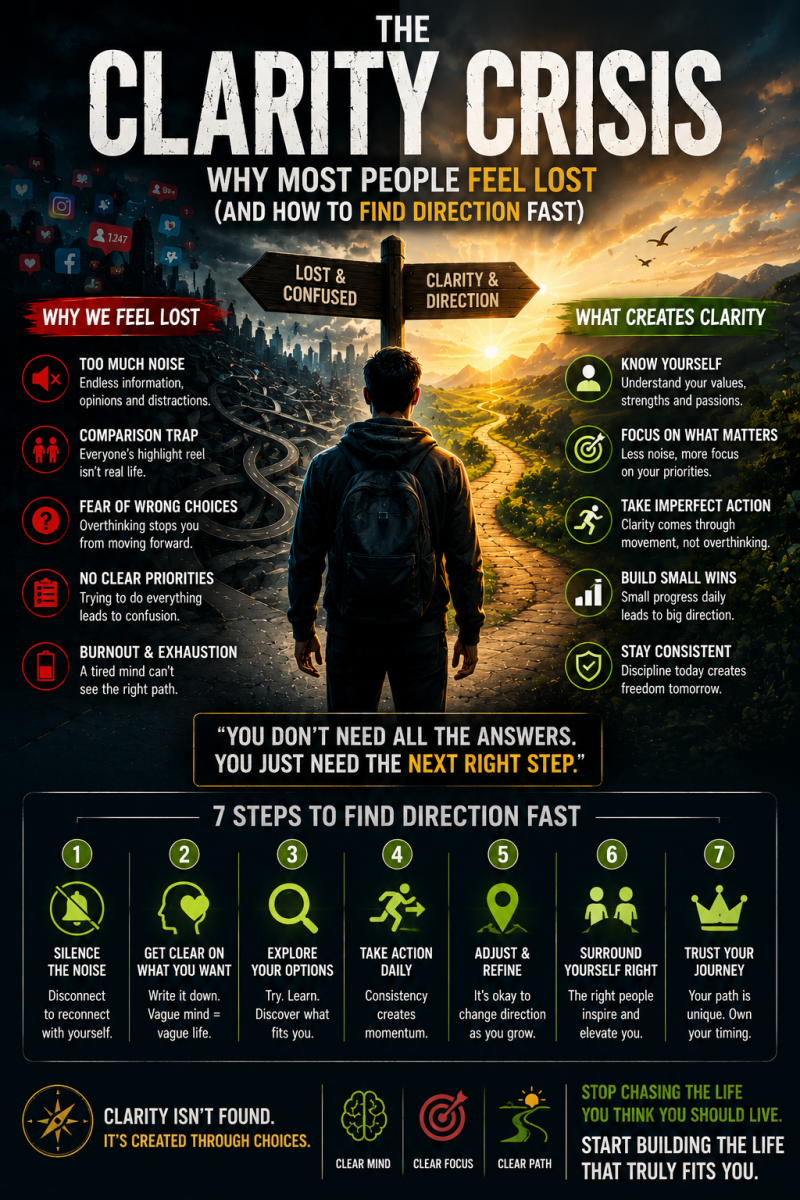
Introduction: Why So Many People Feel Lost Today
A surprising number of adults secretly feel like they’re drifting through life.
They wake up.
Go to work.
Handle responsibilities.
Scroll through distractions.
Repeat the cycle.
But internally, many are asking:
- “What am I really doing with my life?”
- “Why do I feel stuck?”
- “Why does everyone else seem more certain than me?”
Welcome to the modern Clarity Crisis.
A growing psychological struggle where people feel overwhelmed, directionless, emotionally exhausted, and disconnected from purpose.
And here’s the truth most people need to hear:
Feeling lost does not mean your life is falling apart.
It often means your mind is overloaded.
Why Modern Life Creates So Much Confusion
The human brain was never designed to process this much information daily.
Today, you are constantly exposed to:
- opinions
- career pressure
- social media lifestyles
- success comparisons
- endless advice
- nonstop distractions
Your brain becomes crowded.
And crowded minds struggle to hear their own direction clearly.
Humor Break:
At this point, some people have:
- 47 unfinished goals
- 13 productivity apps
- 6 motivational playlists
- and absolutely no idea what they actually want 😄
The Difference Between Being Lost and Being Unclear
Many people think they’re lost.
But often, they’re simply:
- mentally overwhelmed
- emotionally exhausted
- distracted from themselves
There’s a difference.
Being “lost” implies:
No path exists.
Being “unclear” means:
The path is hidden beneath noise.
That’s encouraging.
Because clarity can be rebuilt.
Why Clarity Feels So Hard to Find
There are several psychological reasons.
1. Too Many Choices
Modern life offers endless possibilities.
Careers.
Side hustles.
Business ideas.
Life paths.
Paradoxically, too many choices create paralysis.
Result:
You overthink instead of moving.
2. Comparison Distorts Direction
Social media makes it seem like everyone else:
- knows exactly what they’re doing
- is successful already
- has life figured out
That illusion creates insecurity.
Truth:
Most people are improvising more than they admit.
3. Fear of Making the Wrong Decision
Many people stay stuck because they fear failure.
So instead of choosing imperfectly…
They choose nothing.
Important insight:
Lack of movement creates more confusion than imperfect action.
4. Constant Distraction
Clarity requires reflection.
But modern life rarely gives your brain silence.
If your attention is constantly consumed, your inner direction becomes difficult to hear.
5. Emotional Exhaustion
Burnout reduces clarity.
When mentally drained, everything feels confusing.
Even simple decisions feel heavier.
The Clarity Myth: You Don’t Need Your Entire Life Planned
One of the biggest misconceptions is this:
“I need to figure out my whole future immediately.”
No, you don’t.
Most successful people discovered direction gradually—not instantly.
Reality:
Clarity often appears while moving forward, not while endlessly thinking.
The Problem With Overthinking
Overthinking creates the illusion of productivity.
You feel mentally active…
But nothing changes.
Overthinking usually leads to:
- hesitation
- fear
- paralysis
- self-doubt
Humor Break:
Some people think so much about changing their lives…
Their brain deserves overtime pay 😄
How to Find Direction Faster
Now let’s move from confusion → clarity.
Step 1: Reduce Mental Noise
Clarity grows in calm environments.
Reduce:
- endless scrolling
- unnecessary opinions
- digital overload
- comparison triggers
Your brain needs space to think clearly.
Step 2: Stop Waiting for Perfect Certainty
This is critical.
Many people delay action until they feel 100% sure.
That moment rarely comes.
Truth:
Action creates clarity faster than thinking alone.
Step 3: Focus on What Energizes You
Pay attention to activities that naturally create:
- curiosity
- excitement
- engagement
- fulfillment
Those are clues.
Ask yourself:
“What makes me feel most alive?”
Step 4: Simplify Your Goals
Too many goals create confusion.
Instead of:
Trying to reinvent your entire life overnight…
Choose one meaningful direction to explore.
Step 5: Spend More Time Alone With Your Thoughts
This sounds simple—but it’s powerful.
Many people are disconnected from themselves because they are constantly consuming external noise.
Try:
- quiet walks
- journaling
- reflection time
- screen-free thinking
Step 6: Accept That Direction Evolves
You are allowed to grow.
Your purpose at 20 may differ from your purpose at 40.
That’s normal.
Important:
Clarity is not a fixed destination.
It’s an evolving understanding of yourself.
Step 7: Build Momentum Through Small Wins
Confidence grows through action.
Not endless planning.
Start with:
- one project
- one habit
- one skill
- one step forward
Progress reduces confusion.
Why Purpose Often Comes From Contribution
Many people search for purpose by asking:
“What will make me happy?”
But deeper fulfillment often comes from:
- helping others
- creating value
- meaningful contribution
Truth:
Purpose grows where meaning exists.
The Mature Perspective: Direction Comes From Alignment
As people mature, they often realize:
Real success is not about impressing others.
It’s about alignment between:
- values
- actions
- priorities
- identity
That alignment creates peace.
The Clarity Formula
If you remember nothing else:
- reduce mental noise
- stop overthinking
- take imperfect action
- focus on meaningful progress
- allow direction to evolve
Conclusion: You Are Probably Closer Than You Think
Feeling lost can feel frightening.
But often it’s not a sign that your life is broken.
It’s a sign that:
- your mind is overloaded
- your attention is scattered
- your inner voice has been drowned out
Final Truth:
Clarity rarely arrives as one dramatic revelation.
It usually appears quietly…
Through reflection, action, growth, mistakes, and movement.
So if you currently feel uncertain about your direction in life, remember this:
You do not need all the answers today.
You only need enough clarity for the next step.
And sometimes…
That single step changes everything.
Add comment
Comments