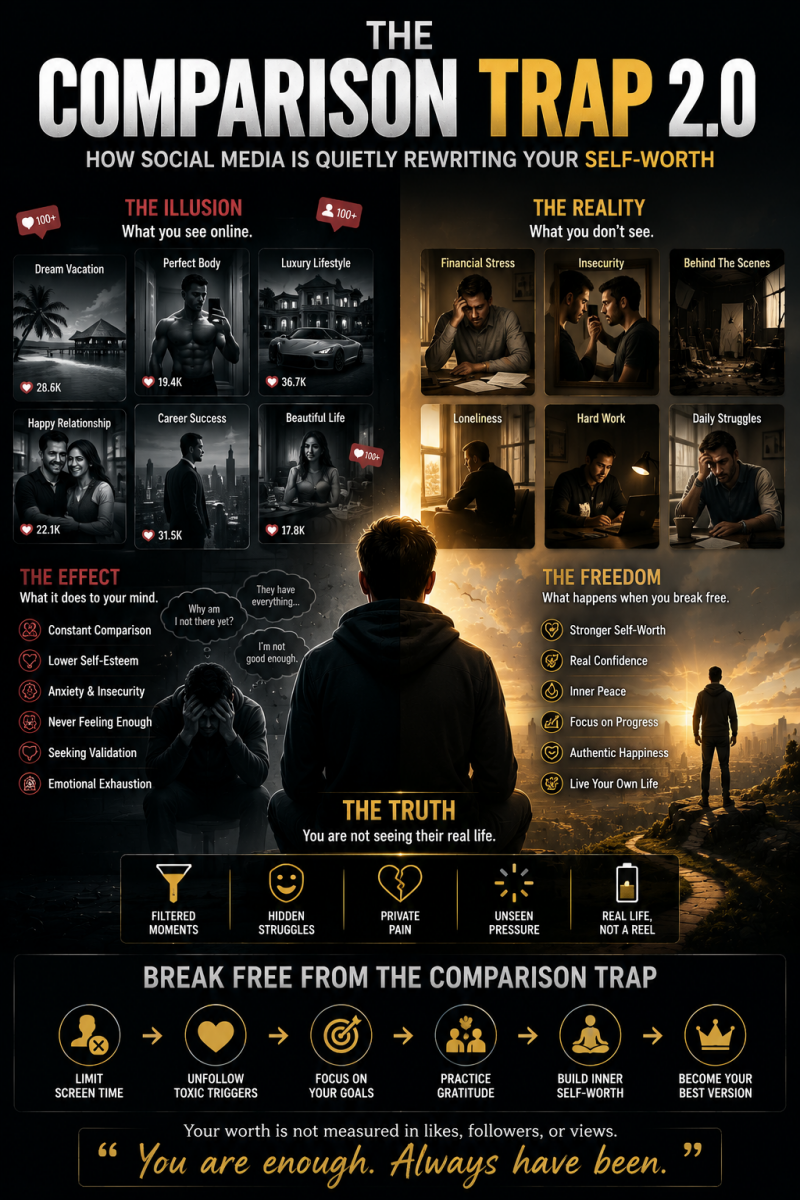
Introduction: The Modern Comparison Crisis
There was a time when people compared themselves mainly to:
- neighbors
- classmates
- coworkers
- family members
Now?
You compare yourself to millions of people every single day.
People with:
- perfect vacations
- perfect relationships
- perfect bodies
- perfect lifestyles
- perfect success stories
All displayed in high-definition… with filters 😄
Welcome to The Comparison Trap 2.0—a modern psychological battle where social media quietly shapes how you see yourself.
And the dangerous part?
Most people don’t even realize it's happening.
Why Social Media Comparison Feels So Powerful
Humans naturally compare themselves to others.
Psychologists call this:
“Social Comparison Theory.”
Your brain constantly evaluates:
- status
- success
- attractiveness
- belonging
In moderation, comparison can motivate growth.
But social media has taken comparison to an entirely different level.
The Problem: You’re Comparing Real Life to Highlight Reels
Social media rarely shows:
- insecurity
- failure
- loneliness
- financial stress
- emotional struggles
Instead, you mostly see:
- celebrations
- achievements
- vacations
- edited beauty
- carefully selected moments
Truth:
You are comparing your behind-the-scenes life
to everyone else’s best-edited moments.
Humor Break:
Some people look rich, peaceful, deeply in love, spiritually balanced, and emotionally healed online…
Then immediately fight over parking spaces in real life 😄
How Social Media Rewrites Self-Worth
The danger is subtle.
Over time, repeated comparison changes how you evaluate yourself.
You begin asking:
- “Am I successful enough?”
- “Why am I behind?”
- “Why doesn’t my life look like that?”
Without noticing, your self-worth becomes tied to external validation.
The Dopamine + Validation Loop
Social media platforms are designed around:
- attention
- engagement
- validation
Likes, comments, and followers create dopamine responses.
Your brain begins associating:
Attention = worth
That’s psychologically dangerous.
Because self-worth becomes dependent on external reaction.
The Confidence Erosion Problem
Constant comparison slowly damages confidence.
Especially when you repeatedly consume content that makes you feel:
- behind in life
- unattractive
- unsuccessful
- unimportant
Important insight:
Comparison rarely inspires confidence.
It usually creates insecurity.
Why Mature Adults Are Also Vulnerable
Many people assume only teenagers struggle with this.
Not true.
Professionals, entrepreneurs, parents, and mature adults are deeply affected, too.
Common comparison triggers:
- career success
- financial lifestyle
- parenting
- relationships
- physical appearance
- aging
Reality:
Social media creates pressure to appear successful—even when people are struggling privately.
The “Everyone Is Winning Except Me” Illusion
One of social media’s biggest psychological distortions is this:
It makes ordinary life feel inadequate.
Suddenly:
- your normal home feels boring
- your progress feels slow
- your achievements feel small
Not because your life lacks value…
But because you are consuming exaggerated versions of everyone else’s lives.
The Mental Health Impact of Constant Comparison
Long-term comparison can contribute to:
- anxiety
- low self-esteem
- depression
- dissatisfaction
- emotional exhaustion
Why?
Because your brain constantly feels like it’s losing a competition that never ends.
The Comparison Trap and Identity
Social media can slowly disconnect people from their authentic identity.
Instead of asking:
“What truly matters to me?”
People begin asking:
“What gets approval?”
That shift is dangerous.
Humor Break:
Some people don’t even enjoy experiences anymore.
They enjoy posting experiences 😄
Why External Validation Never Fully Satisfies
Validation feels good temporarily.
But it fades quickly.
That’s why people constantly seek:
- more likes
- more attention
- more approval
It becomes an emotional treadmill.
Truth:
Self-worth built on public approval will always feel unstable.
How to Escape the Comparison Trap
The goal is not to quit technology completely.
It’s to regain psychological balance.
Step 1: Curate Your Digital Environment
Your feed affects your mindset.
Ask:
- Does this content inspire me or drain me?
- Do I feel worse after consuming it?
Unfollow accounts that constantly trigger insecurity.
Step 2: Reduce Passive Scrolling
Mindless scrolling increases comparison.
Intentional usage reduces it.
Practical fix:
Use social media with purpose—not as endless emotional entertainment.
Step 3: Reconnect With Real Life
Offline experiences matter.
Prioritize:
- real conversations
- hobbies
- family time
- nature
- meaningful work
Reality restores perspective.
Step 4: Focus on Your Own Timeline
Everyone’s life path is different.
Social media compresses thousands of life journeys into one endless feed.
That creates unrealistic expectations.
Important truth:
You are not behind.
You are on your own timeline.
Step 5: Build Internal Validation
This is powerful.
Learn to value yourself based on:
- character
- growth
- discipline
- integrity
Not public attention.
Step 6: Practice Gratitude
Comparison focuses on what you lack.
Gratitude focuses on what you already have.
That shift changes emotional perspective dramatically.
Step 7: Remember That Social Media Is a Business
Platforms are designed to keep your attention.
Emotional triggers increase engagement.
That includes:
- envy
- outrage
- insecurity
- comparison
Understanding this gives you psychological distance.
The Mature Perspective: Peace Is More Valuable Than Performance
At a certain point in life, mature wisdom realizes:
Inner peace matters more than online appearance.
Not everything meaningful needs validation.
Not every success needs broadcasting.
And not every life needs to look impressive online to be valuable.
The Self-Worth Formula
If you remember nothing else:
- reduce comparison
- protect your attention
- build internal confidence
- focus on real-life growth
- value authenticity over approval
Conclusion: Your Worth Cannot Be Measured by a Screen
Social media can be entertaining, useful, and inspiring.
But it can also quietly distort:
- self-worth
- confidence
- happiness
- identity
Especially when comparison becomes constant.
Final Truth:
Your value does not decrease because someone else appears successful online.
So the next time social media makes you feel “less than,” pause and remember:
You are seeing a carefully edited fraction of reality.
Not the full truth.
And your real life—
With its growth, struggles, lessons, and progress—
It is still valuable, meaningful, and worthy.
Even without filters.
Add comment
Comments