Introduction: The Strange Frustration of Knowing Better
You already know what you should do.
- Exercise more
- Eat healthier
- Stop procrastinating
- Focus on your goals
- Sleep earlier
- Spend less time scrolling
The information is not the problem.
So why is it still so hard to follow through?
Why do intelligent, capable people continue repeating behaviors they know are holding them back?
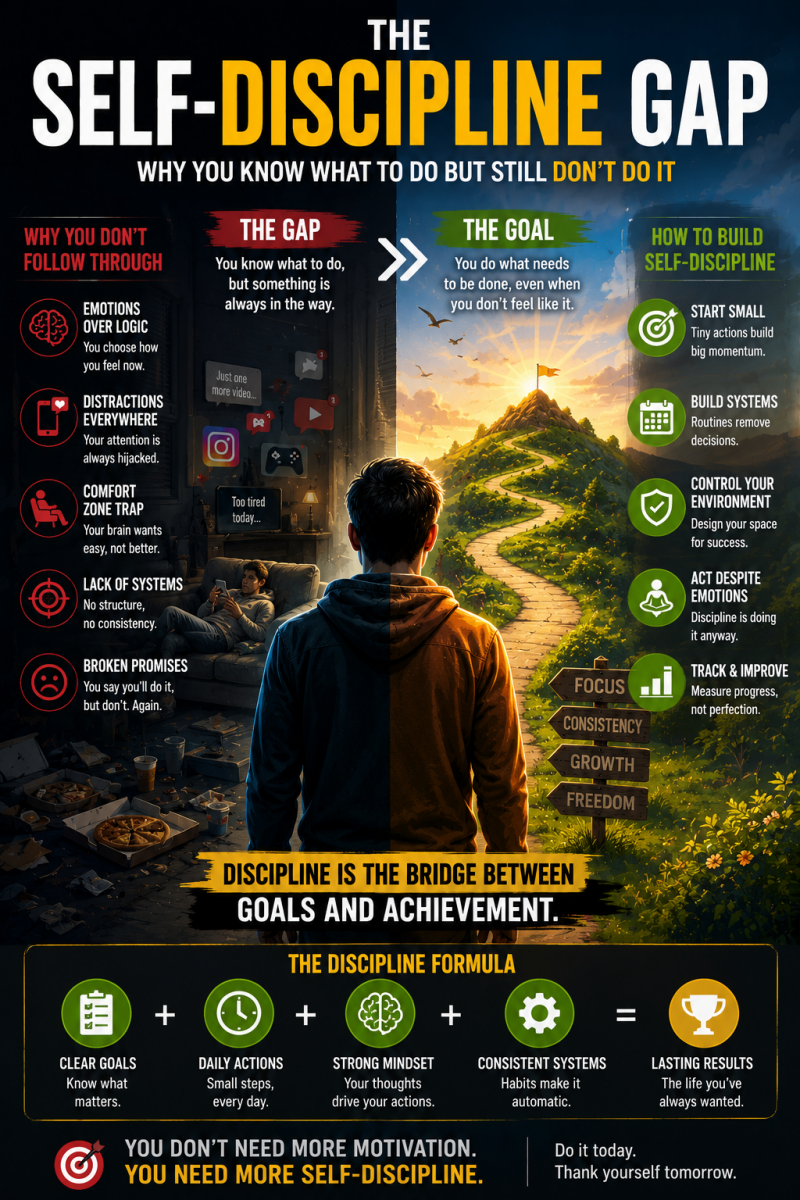
Welcome to the Self-Discipline Gap:
The painful distance between what you know… and what you consistently do.
And here’s the surprising truth:
Discipline is not mainly about intelligence.
It’s about psychology, systems, habits, and emotional control.
What Is Self-Discipline (Really)?
Self-discipline is the ability to:
- act intentionally
- resist short-term temptation
- stay consistent despite emotions
It means doing what benefits your future—even when your present mood disagrees.
Important insight:
Discipline is not punishment.
It’s self-leadership.
Why Knowledge Alone Doesn’t Change Behavior
Humans are not purely logical creatures.
If knowledge alone changed lives:
- everyone would be healthy
- nobody would procrastinate
- and nobody would say “I’ll start Monday” every single week 😄
The real issue is this:
Your brain prefers comfort over effort.
The Brain’s Constant Battle
Inside your mind are two competing systems.
System 1: Immediate Gratification
This part wants:
- comfort
- pleasure
- easy rewards
- entertainment
System 2: Long-Term Growth
This part wants:
- discipline
- progress
- goals
- improvement
The problem?
Immediate rewards usually feel stronger than future rewards.
That’s why:
- Scrolling beats studying
- Snacks beat healthy eating
- comfort beats consistency
The Discipline Myth
Many people think disciplined people:
- always feel motivated
- have stronger personalities
- never struggle
False.
Disciplined people learn how to:
Act independently of mood.
Humor Break:
Undisciplined brain:
“I don’t feel like doing it.”
Disciplined brain:
“That’s fascinating. We’re doing it anyway.” 😄
Why You Keep Breaking Promises to Yourself
This is one of the biggest hidden problems.
Every time you repeatedly avoid action, your brain learns:
“I can’t trust myself to follow through.”
That damages:
- confidence
- consistency
- self-respect
Truth:
Self-discipline is deeply connected to self-trust.
The Hidden Causes of Poor Discipline
Let’s go deeper.
1. Emotional Decision-Making
Many people make decisions based on feelings.
But feelings constantly change.
Example:
Motivated Sunday:
“Starting tomorrow, everything changes.”
Tired Tuesday:
“Maybe next week.”
2. Overstimulation
Constant digital stimulation weakens focus and patience.
Your brain becomes addicted to quick rewards.
3. Lack of Systems
Goals without systems create inconsistency.
Example:
Goal:
“Get fit.”
System:
- workout schedule
- meal prep
- accountability
4. Perfectionism
Some people avoid action because they fear imperfection.
So they wait for the “perfect moment.”
Which never comes.
5. Environmental Problems
Your environment shapes behavior more than you realize.
Example:
Trying to focus while your phone is beside you is like dieting while carrying a pizza everywhere.
The Real Secret: Discipline Is Built, Not Born
Nobody wakes up magically disciplined.
Discipline develops through:
- repetition
- structure
- small wins
- consistency
How to Build Self-Discipline (Practically)
Let’s move from psychology → action.
Step 1: Start Smaller Than You Want To
This is critical.
Most people fail because they start too aggressively.
Instead of:
“2 hours every day.”
Start with:
“10–15 minutes consistently.”
Why it works:
Small actions reduce resistance.
Step 2: Remove Friction
Make good habits easier.
Example:
- prepare workout clothes beforehand
- keep healthy food visible
- reduce distractions
Step 3: Build Systems, Not Just Goals
Goals inspire.
Systems sustain.
Truth:
You do not rise to your goals.
You fall to your knees.
Step 4: Stop Negotiating With Yourself
This is powerful.
When disciplined people decide to act, they act.
They don’t endlessly debate with their emotions.
Example:
Instead of:
“Should I work out today?”
The answer becomes:
“This is what I do.”
Step 5: Use Identity-Based Discipline
Shift from:
“I’m trying to be disciplined.”
To:
“I am becoming someone who follows through.”
Identity shapes behavior.
Step 6: Expect Resistance
Discomfort is normal.
Not failure.
Your brain naturally resists effort.
Mature mindset:
“I don’t need to feel ready to begin.”
Step 7: Reward Consistency
Celebrate small wins.
Your brain needs reinforcement.
Important:
Consistency matters more than intensity.
Why Discipline Creates Freedom
Many people think discipline is restrictive.
But the opposite is true.
Discipline creates:
- financial freedom
- better health
- confidence
- peace of mind
- long-term success
Lack of discipline creates:
- stress
- regret
- chaos
- missed opportunities
The Mature Perspective: Discipline Is Emotional Maturity
Real discipline is not harshness.
It’s emotional maturity.
It means understanding:
“I will not always feel motivated, but I can still act wisely.”
That mindset changes lives.
The Discipline Formula (Simple Version)
If you remember nothing else:
- start small
- reduce friction
- build systems
- act despite emotion
- repeat consistently
Conclusion: Your Future Is Built by What You Repeatedly Do
Everyone wants results.
But results come from repeated behavior.
And repeated behavior comes from discipline.
Final Truth:
Success is rarely about knowing more.
It’s usually about doing consistently what you already know.
So the next time you catch yourself saying:
“I know what to do… I’m just not doing it.”
Pause and ask:
“What small action can I commit to today—without negotiation?”
Then follow through.
Because every time you keep a promise to yourself…
You become stronger.
And eventually, discipline stops feeling like punishment.
It starts feeling like power.
Add comment
Comments