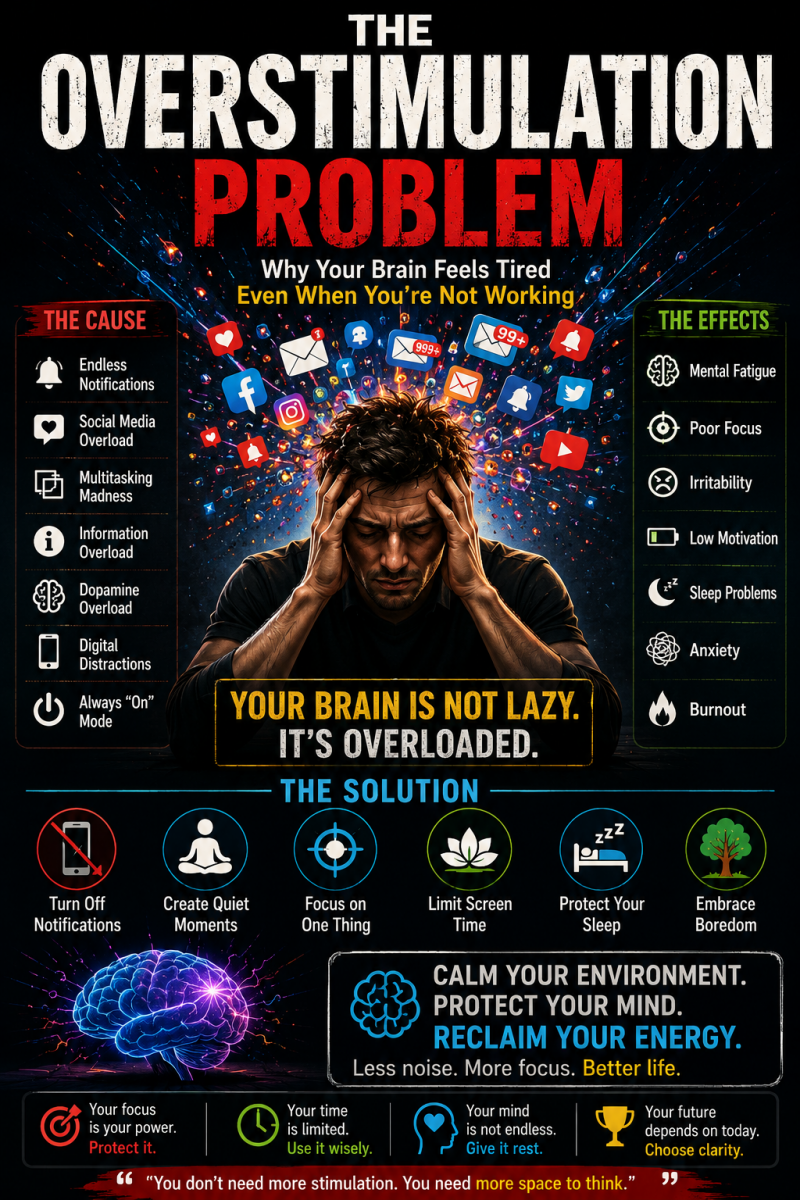
Introduction: Why Are You So Mentally Tired?
Have you ever reached the end of the day and thought?
“I’m exhausted… but what did I actually do?”
You weren’t lifting heavy boxes.
You weren’t running marathons.
You may not have even worked that hard physically.
And yet your brain feels like it just completed a full-season championship series.
Welcome to the modern problem of overstimulation.
A hidden form of mental overload that millions of people experience daily without fully understanding it.
What Is Overstimulation?
Overstimulation happens when your brain receives:
- too much information
- too many decisions
- too many interruptions
- too much sensory input
All at the same time.
Your brain becomes overwhelmed trying to process everything.
Common sources of overstimulation:
- social media
- constant notifications
- multitasking
- endless scrolling
- loud environments
- nonstop entertainment
- information overload
Truth:
Your brain was not designed for constant stimulation 24/7.
The Digital World Never Stops
Modern life has removed boredom almost entirely.
Waiting in line? → Phone.
Eating alone? → Phone.
Bathroom break? → Surprisingly… also phone 😄
Your brain rarely gets silence anymore.
And that’s creating a serious mental energy problem.
The Dopamine Overload Effect
Every:
- notification
- like
- message
- video
- scroll
Creates tiny dopamine spikes.
Dopamine is the brain chemical linked to:
- reward
- pleasure
- motivation
But constant dopamine stimulation creates an imbalance.
What happens next?
Your brain becomes:
- restless
- distracted
- mentally fatigued
- less satisfied with normal activities
Humor Break:
Your brain used to celebrate survival.
Now it celebrates:
“Congratulations! You watched 17 short videos and learned absolutely nothing.” 😄
Why Overstimulation Feels So Exhausting
Mental fatigue is not only caused by hard work.
It’s also caused by:
- constant switching of attention
- emotional overload
- sensory bombardment
- information processing
Your brain burns energy filtering all the noise.
Signs You’re Overstimulated
You may be overstimulated if you often feel:
- mentally tired but physically restless
- unable to focus deeply
- irritated by small things
- emotionally drained
- constantly distracted
- overwhelmed without an obvious reason
Another major sign:
You struggle to sit quietly without reaching for your phone.
The Attention Fragmentation Problem
Your attention is constantly divided.
Example:
You try to work…
Then:
- message notification
- email alert
- social media check
- random thought
- another tab
- another distraction
By the end, your brain feels crowded.
Because it is.
Why Rest Doesn’t Feel Restful Anymore
Many people think they’re resting when they’re actually overstimulating themselves differently.
Example:
You finish work and immediately:
- scroll social media
- binge content
- jump between apps
Your body stops working…
But your brain keeps processing.
Result:
You never fully recover mentally.
The Hidden Cost of Constant Stimulation
Overstimulation affects more than focus.
It impacts:
- sleep quality
- emotional regulation
- creativity
- patience
- memory
- productivity
Truth:
A constantly stimulated brain becomes a constantly exhausted brain.
The Brain Was Built for Cycles
Humans were designed for:
- focus
- rest
- stimulation
- recovery
But modern life pushes nonstop stimulation.
Your nervous system never fully resets.
Why Silence Feels Uncomfortable Now
Many people struggle with silence because their brains have adapted to constant input.
Silence now feels:
- boring
- uncomfortable
- “Too quiet.”
But silence is often exactly what the brain needs.
Humor Break:
Some people are so overstimulated…
They open one app while already watching another app…
while listening to a podcast…
while wondering why they can’t focus 😄
How to Reduce Overstimulation
The goal is not to eliminate technology.
It’s to create a healthier mental balance.
Step 1: Reduce Notification Noise
Notifications train your brain to stay reactive.
Simple fix:
- turn off unnecessary alerts
- stop checking your phone constantly
- create intentional phone-free periods
Step 2: Create Quiet Moments
Your brain needs pauses.
Examples:
- walks without your phone
- quiet mornings
- moments of silence
- screen-free breaks
Step 3: Limit Endless Scrolling
Social media overloads your attention system.
Try:
- time limits
- intentional usage
- avoiding mindless scrolling
Step 4: Focus on One Thing at a Time
Single-tasking calms the brain.
Multitasking overstimulates it.
Step 5: Protect Your Sleep
Overstimulated brains struggle to recover.
Especially with excessive screen exposure at night.
Improve sleep by:
- reducing nighttime screen time
- creating calming evening routines
- limiting stimulation before bed
Step 6: Reintroduce Boredom
This sounds strange—but it’s powerful.
Boredom allows your brain to:
- recover
- process thoughts
- reset attention
Important insight:
Not every moment needs entertainment.
The Mature Perspective: Mental Peace Is a Competitive Advantage
In today’s hyper-distracted world, calmness is powerful.
People who can:
- think clearly
- focus deeply
- stay mentally balanced
Have a major advantage.
The Overstimulation Recovery Formula
If you remember nothing else:
- reduce digital noise
- protect attention
- embrace quiet moments
- single-task more
- allow mental recovery
Conclusion: Your Brain Needs Less Noise, Not More
Modern life constantly pushes stimulation.
More content.
More scrolling.
More notifications.
More noise.
But your brain was not designed for nonstop consumption.
Final Truth:
Mental peace is not laziness.
It is recovery.
So the next time you feel mentally exhausted for “no reason,” ask yourself:
“Am I truly tired… or am I overstimulated?”
That question alone could change your entire relationship with technology, focus, and mental health.
Because sometimes the most productive thing you can do…
It gives your brain a moment of silence.
Add comment
Comments