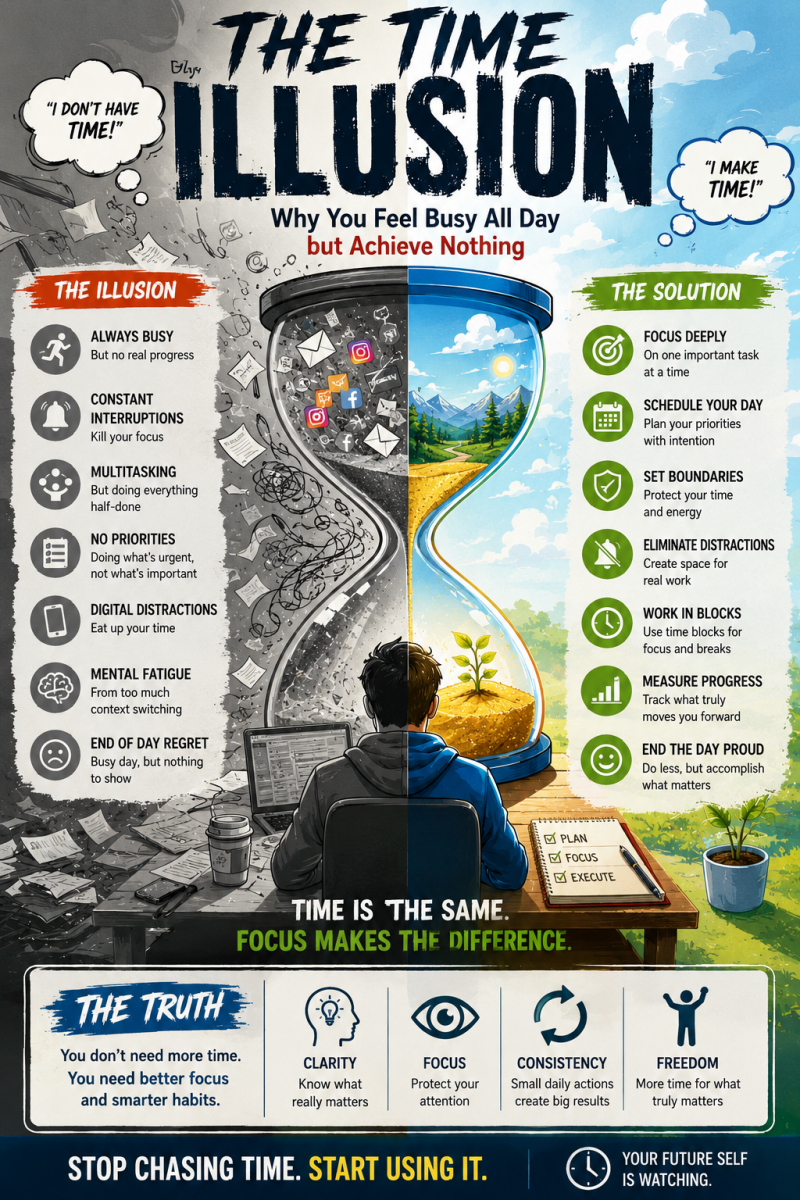
Introduction: Where Did the Whole Day Go?
You wake up motivated.
You have plans.
Goals.
A to-do list that looks impressively ambitious.
Then suddenly…
It’s evening.
You’re mentally exhausted.
And somehow the most important things still didn’t get done.
Sound familiar?
Welcome to the Time Illusion—the strange modern experience of being busy all day while accomplishing surprisingly little.
And here’s the uncomfortable truth:
The problem is often not lack of time.
It’s how your attention and energy are being consumed.
Why Time Feels Like It’s Moving Faster
As adults, time seems to disappear more quickly.
Weeks blur together.
Months vanish.
Entire years suddenly feel like “a few months ago.”
Psychologists believe this happens because:
- routines become repetitive
- attention becomes fragmented
- The brain processes fewer memorable experiences
But there’s another major factor:
Constant distraction.
The Modern Attention Crisis
Today’s world is designed to interrupt you.
Notifications.
Emails.
Social media.
Messages.
Meetings.
Your attention is constantly being pulled in different directions.
The result?
You spend the day reacting instead of progressing.
Humor Break:
Modern productivity sometimes looks like this:
- open laptop
- check email
- reply to one message
- remember another task
- check phone “quickly.”
- accidentally watch three videos
- suddenly hungry
- somehow it’s 4 PM 😄
The Difference Between Activity and Achievement
This is one of the biggest productivity traps.
You confuse movement with progress.
Activity:
- replying to emails
- checking notifications
- attending unnecessary meetings
- multitasking constantly
Achievement:
- finishing meaningful work
- solving important problems
- making measurable progress
Truth:
Being busy is easy.
Being effective requires intention.
Why You Feel Exhausted Without Results
Mental fatigue doesn’t only come from hard work.
It also comes from:
- constant task-switching
- decision overload
- digital distractions
- unfinished mental loops
Your brain becomes overwhelmed even without deep productivity.
The Hidden Productivity Killers
Let’s expose the real culprits.
1. Constant Multitasking
Your brain is not designed for multiple deep tasks simultaneously.
Task-switching drains energy.
Result:
- slower thinking
- more mistakes
- lower focus
2. Notification Addiction
Every notification steals attention.
Even brief interruptions break concentration.
Studies show:
It can take several minutes to fully regain focus after an interruption.
3. Lack of Priorities
Many people start the day without clarity.
So they react to whatever feels urgent.
Important insight:
Urgent is not always important.
4. Decision Fatigue
Every small decision drains mental energy.
What to wear.
What to answer.
What to do next.
By evening, your brain is tired.
5. Digital Time Distortion
Social media and endless scrolling distort time perception.
You think:
“I’ll just check for 5 minutes.”
Then somehow you’ve become emotionally invested in a stranger arguing about pineapple on pizza 😄
The Psychology of “Fake Productivity”
Some tasks feel productive because they provide:
- quick dopamine
- visible activity
- immediate response
But they don’t necessarily create progress.
Examples:
- organizing files endlessly
- checking email repeatedly
- rewriting the same plan instead of executing it
The Real Cause: Lack of Deep Focus
The modern world trains shallow attention.
But meaningful work requires deep focus.
Without focus:
- time fragments
- energy scatters
- progress slows
How to Escape the Time Illusion
The solution is not working harder.
It’s working more intentionally.
Step 1: Identify Your “Real Work”
Ask yourself:
“What actually moves my life forward?”
Not everything deserves equal attention.
Step 2: Focus on 1–3 Important Tasks Daily
Too many goals create chaos.
Simpler approach:
Choose:
- 1 major task
- 2 smaller priorities
Then focus deeply.
Step 3: Protect Your Attention
Attention is your most valuable resource.
Reduce distractions:
- silence notifications
- close unnecessary tabs
- schedule focused work sessions
Step 4: Use Time Blocks
Structure helps your brain focus.
Example:
- 45 minutes focused work
- short break
- repeat
Step 5: Stop Measuring Productivity by Busyness
Ask:
“What did I complete today?”
Not:
“How busy did I feel?”
Step 6: Create Recovery Time
Constant mental stimulation destroys clarity.
Your brain needs:
- rest
- silence
- recovery moments
Humor Break:
Some people schedule every minute of their day…
Then wonder why their brain feels like an overheated laptop 😄
Step 7: Audit Where Your Time Actually Goes
Most people underestimate wasted time.
Track your day honestly.
You may discover:
- interruptions consume hours
- phone usage is higher than expected
- shallow tasks dominate your schedule
The Mature Perspective: Productivity Is About Clarity
For mature professionals and entrepreneurs, real productivity is not:
- nonstop hustle
- endless multitasking
- looking busy
It’s:
Focused effort applied to meaningful priorities.
The Time Formula (Simple Version)
If you remember nothing else:
- focus on fewer things
- protect attention
- reduce distractions
- prioritize meaningful work
- rest intentionally
Conclusion: Your Time Is Being Spent—Whether You Notice or Not
Time rarely disappears dramatically.
It disappears quietly.
Through distractions.
Interruptions.
Mindless habits.
Mental clutter.
And before you know it, the day is gone.
Final Truth:
You don’t need more hours in the day.
You need greater awareness of where your attention is going.
So the next time you finish a busy day feeling strangely unaccomplished, pause and ask:
“Did I spend my day reacting… or progressing?”
That question alone can change your entire approach to productivity.
Add comment
Comments