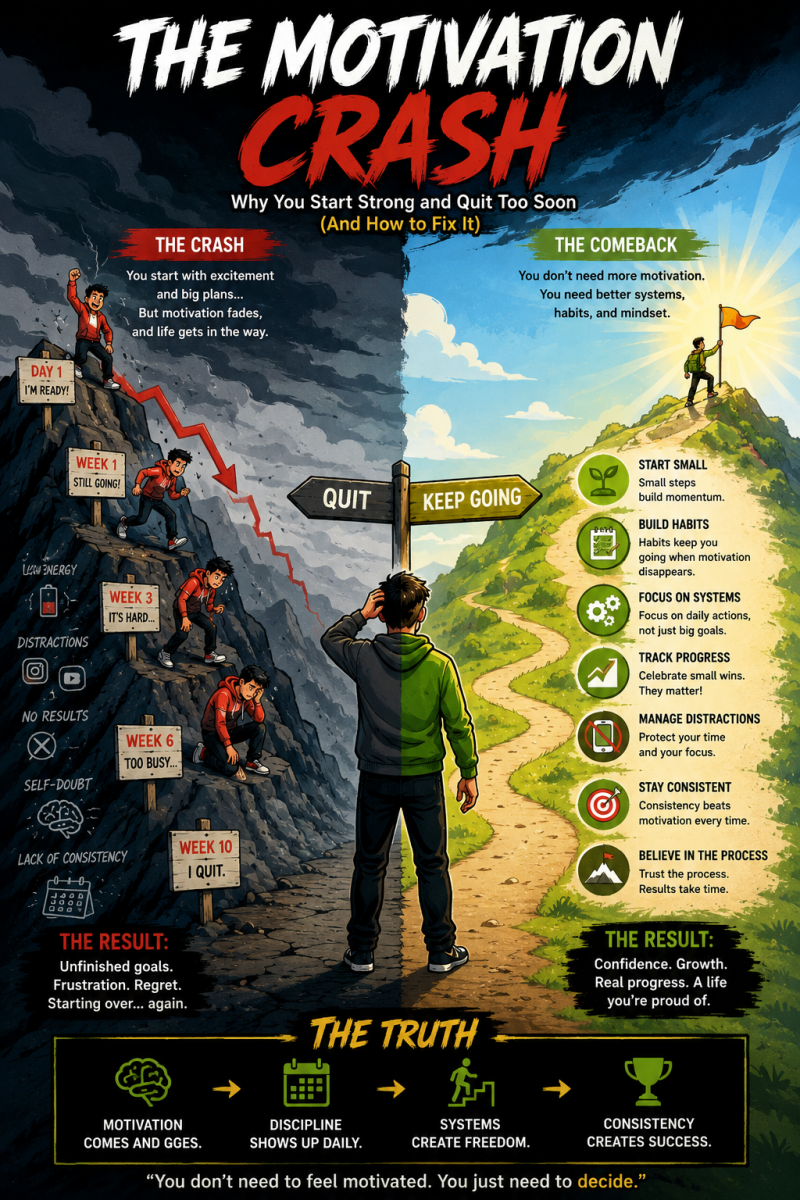
Introduction: The Excitement That Never Lasts
You know the feeling.
A new goal.
A fresh plan.
A powerful burst of motivation.
You tell yourself:
- “This time I’m serious.”
- “I’m going all in.”
- “My life is about to change.”
For a few days—or weeks—you’re unstoppable.
Then suddenly…
The energy fades.
The excitement disappears.
And somehow your “new life” quietly becomes another unfinished project sitting next to:
- the unread books
- the abandoned workout plan
- and the online course you swore you’d finish 😄
Welcome to the Motivation Crash.
And no—it’s not because you’re lazy.
It’s because motivation was never designed to carry you forever.
The Truth About Motivation
Motivation is emotional energy.
And emotions fluctuate.
Some days you feel unstoppable.
Other days, you feel like your brain has filed for early retirement.
That’s normal.
Here’s the key insight:
Motivation is excellent for starting.
But terrible for sustaining.
Why Motivation Feels So Powerful at First
At the beginning of a goal, your brain experiences:
- excitement
- novelty
- possibility
- dopamine spikes
Everything feels fresh and inspiring.
Your brain says:
“This is the new me.”
But eventually, reality appears.
The task becomes harder.
Results slow down.
Effort increases.
And that’s when motivation begins to fade.
The Psychology Behind the Motivation Crash
There are several reasons why people lose momentum.
1. The Novelty Effect Wears Off
Your brain loves new experiences.
But once something becomes routine, the excitement drops.
Example:
Day 1 of the gym:
“Let’s transform our life!”
Week 3:
“Maybe walking to the fridge counts as cardio.”
2. Unrealistic Expectations
Many people expect:
- rapid progress
- instant transformation
- constant motivation
When reality feels slower, discouragement appears.
3. Results Take Longer Than Feelings
You often stop seeing visible progress before real results arrive.
That’s dangerous psychologically.
Because humans are wired to respond to visible rewards.
4. Motivation Depends on Emotion
And emotions are unstable.
Stress, exhaustion, distractions, and life pressure all reduce motivation.
5. Lack of Systems
Most people rely on mood instead of structure.
So when motivation disappears, consistency disappears too.
The Big Lie About Successful People
Many people assume successful individuals are always motivated.
Not true.
What they actually have is:
Systems, habits, and discipline.
They don’t rely on feeling inspired every day.
They rely on routines that continue even when motivation fades.
Motivation vs Consistency
Motivation says:
“I feel like doing it.”
Consistency says:
“I’ll do it whether I feel like it or not.”
Truth:
Long-term success is built more on consistency than intensity.
The Motivation Trap: Starting Too Big
Another major problem?
People often try to change everything at once.
Example:
- wake up at 5 AM
- work out daily
- meditate
- read 50 pages
- drink only water
- become a productivity machine overnight
Your brain responds:
“Absolutely not.”
Humor Break:
Some people create routines so intense…
Even professional athletes would ask for a recovery day 😄
Why Discipline Beats Motivation
Discipline is not about punishment.
It’s about creating reliable behavior.
Motivation:
Temporary
Discipline:
Repeatable
Key insight:
Motivation gets you started.
Discipline keeps you moving.
How to Fix the Motivation Crash
Now let’s talk solutions.
Step 1: Stop Relying on Feelings
This is the biggest shift.
Instead of asking:
“Do I feel motivated?”
Ask:
“What does my system say to do?”
Step 2: Make Goals Smaller
Tiny, consistent actions beat massive, unsustainable effort.
Example:
Instead of:
“I’ll work out 2 hours daily.”
Try:
“I’ll do 15 minutes consistently.”
Why it works:
Small wins build momentum.
Step 3: Build Identity-Based Habits
Don’t focus only on outcomes.
Focus on identity.
Instead of:
“I want to write a book.”
Think:
“I am becoming someone who writes daily.”
Step 4: Remove Friction
Make good habits easier.
Examples:
- Prepare your workspace early
- Keep distractions away
- Simplify routines
Step 5: Expect Motivation to Fade
This is normal.
Not failure.
Important mindset:
You are not supposed to feel inspired every day.
Consistency matters more.
Step 6: Track Progress
Your brain needs evidence of growth.
Track:
- days completed
- habits maintained
- small wins
Progress builds confidence.
Step 7: Focus on Systems, Not Just Goals
Goals create direction.
Systems create results.
Example:
Goal:
“Lose weight.”
System:
- healthy meals
- regular movement
- better sleep
Step 8: Learn to Work Through Resistance
Some days will feel harder.
That’s part of growth.
Mature mindset:
“I may not feel motivated today…
But I still move forward.”
The Emotional Reality of Long-Term Growth
Real transformation is often boring.
Not dramatic.
Not exciting.
Just repeated daily action.
Truth:
The people who succeed long-term are not always the most talented.
They are often the most consistent.
The Consistency Formula
If you remember nothing else:
- start small
- repeat daily
- reduce friction
- rely on systems
- expect emotional ups and downs
Conclusion: Motivation Is Temporary—Systems Are Powerful
Motivation feels amazing.
But it was never meant to carry your entire life.
The secret to long-term success is not staying constantly inspired.
It’s learning how to continue when inspiration disappears.
Final Truth:
You do not need endless motivation.
You need reliable habits and consistent action.
So the next time motivation fades, don’t panic.
Don’t quit.
Don’t assume you’ve failed.
Instead, ask yourself:
“What small action can I still take today?”
Then take it.
Because greatness is rarely built through giant emotional moments.
It’s built through quiet consistency.
One day at a time.
Add comment
Comments