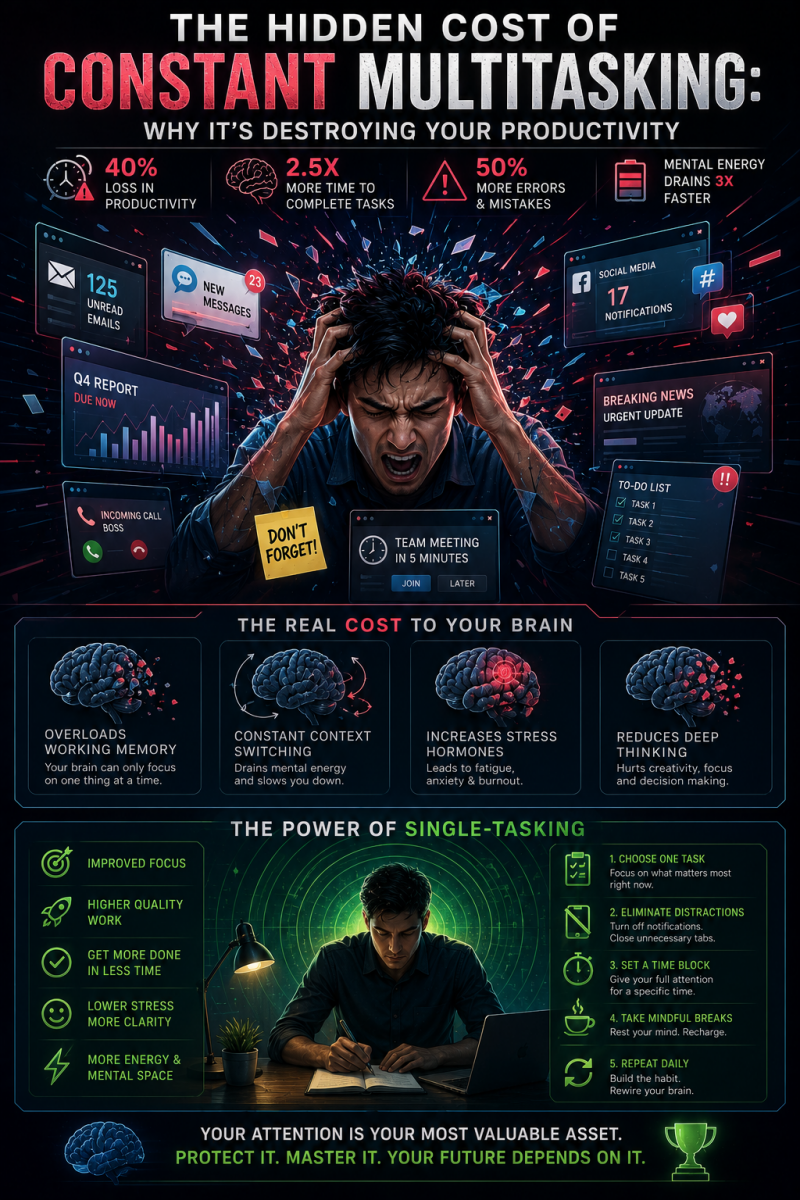
Introduction: The Myth of “Doing It All”
Modern life celebrates multitasking.
People proudly say things like:
- “I’m answering emails while on a meeting.”
- “I can work and watch TV at the same time.”
- “I’m good at multitasking.”
But neuroscience has some bad news:
Your brain is not built for true multitasking.
In fact, what most people call multitasking is actually:
Rapid task-switching—and it comes with a serious cost.
The scary part?
Most people don’t even realize how much productivity they’re losing.
What Is Multitasking (Really)?
Multitasking is attempting to perform multiple mentally demanding tasks at once.
Examples:
- checking emails during meetings
- texting while working
- writing while scrolling social media
- switching constantly between tabs
Here’s the catch:
Your brain isn’t truly doing several things simultaneously.
It’s rapidly switching attention back and forth.
And every switch drains mental energy.
The Science Behind Task-Switching
Every time your brain changes focus, it must:
- stop one mental process
- reload another
- reorient attention
This creates what psychologists call:
“Attention residue.”
Part of your brain remains stuck on the previous task.
Translation:
Even after switching tasks, your mind is still partially thinking about the last one.
So your concentration weakens.
Humor Break:
Your brain during multitasking:
“Let’s answer this email…
wait, notification…
What was I doing again?
Oh right… Where’s that document?
Actually, let me check one quick video first.”
Forty-five minutes later:
Nothing meaningful completed 😄
Why Multitasking Feels Productive
Multitasking creates the illusion of productivity because:
- you feel active
- your brain gets constant stimulation
- You appear busy
But activity is not the same as effectiveness.
Truth:
Multitasking increases movement…
but reduces meaningful progress.
The Hidden Costs of Constant Multitasking
Let’s talk about what multitasking is quietly doing to your brain and performance.
1. Reduced Focus
Every interruption weakens concentration.
And deep focus is where real productivity happens.
Result:
- slower thinking
- reduced creativity
- poor-quality work
2. Increased Mental Fatigue
Task-switching burns cognitive energy.
Your brain works harder just to keep up.
That’s why:
You can feel exhausted… even when you haven’t done much meaningful work.
3. More Mistakes
Multitasking reduces accuracy.
Your brain misses details when attention is divided.
Example:
Ever sent a message to the wrong person?
That’s multitasking, introducing chaos into your life 😄
4. Lower Memory Retention
Your brain remembers less when attention is fragmented.
Why?
Memory requires focused attention.
Without focus, information doesn’t stick properly.
5. Increased Stress Levels
Constant switching keeps your brain in a reactive state.
Your nervous system never fully settles.
Result:
- overwhelm
- anxiety
- mental clutter
The Focus vs Multitasking Battle
Focus creates depth.
Multitasking creates fragmentation.
Focused Work:
- deeper thinking
- faster completion
- better quality
Multitasking:
- scattered attention
- unfinished tasks
- mental exhaustion
Key insight:
The brain performs best when fully engaged in one meaningful task.
Why Modern Technology Makes It Worse
Today’s world is designed to interrupt you.
Notifications.
Messages.
Emails.
Apps.
Every platform competes for your attention.
Your phone is not neutral.
It is engineered to:
- pull attention
- trigger curiosity
- create habit loops
Humor Break:
You open your phone to check one message…
Suddenly, you’re watching a cooking video, reading comments, and wondering how you ended up there.
Your original task? Gone.
The Productivity Trap: Being Busy but Ineffective
Many people spend entire days multitasking.
By evening, they feel:
- mentally drained
- emotionally overwhelmed
- strangely unaccomplished
Because multitasking creates mental noise without meaningful output.
How to Break the Multitasking Habit
The goal is not to become slower.
It’s to become more intentional.
Step 1: Single-Task Whenever Possible
One task. One focus.
Fully engage with it.
Rule:
What you focus on grows.
Step 2: Silence Notifications
Notifications destroy concentration.
Simple fix:
- turn off non-essential alerts
- use “Do Not Disturb” mode
- check messages intentionally
Step 3: Work in Focus Blocks
Use uninterrupted time sessions.
Example:
- 30–60 minutes focused work
- short break
- repeat
Step 4: Batch Similar Tasks
Group similar activities together.
Example:
- answer emails at specific times
- make calls together
- schedule meetings together
This reduces mental switching.
Step 5: Create a Distraction-Free Environment
Your environment affects attention.
Improve focus by:
- cleaning your workspace
- reducing noise
- limiting open tabs
Step 6: Train Your Attention Span
Focus is like a muscle.
The more you practice sustained attention, the stronger it becomes.
Start small:
- 15 minutes uninterrupted
- then increase gradually
The Mature Advantage: Depth Over Speed
Mature professionals often realize something younger workers overlook:
Real success comes from depth—not constant activity.
Deep thinkers outperform distracted workers over time.
The Productivity Shift
Instead of asking:
“How much can I do at once?”
Ask:
“How fully can I focus on what matters most?”
That question changes everything.
The Focus Formula (Simple Version)
If you remember nothing else:
- do one thing at a time
- eliminate distractions
- protect focus
- reduce switching
- repeat daily
Conclusion: Multitasking Is Costing You More Than You Think
Multitasking feels efficient.
But it is quiet:
- reduces focus
- increases stress
- weakens productivity
- drains mental energy
The modern world trains distraction.
But meaningful success still requires concentration.
Final Thought:
You don’t need to do more things at once.
You need to do fewer things—with greater focus.
So the next time you’re tempted to juggle five things simultaneously, pause and ask:
“Would this be faster—and better—if I focused fully on one thing?”
The answer is usually yes.
And your brain will thank you for it.
Add comment
Comments