Introduction: The Age of Distraction
Let’s be honest.
Focusing today feels like trying to read a book…
in the middle of a party…
while someone keeps shouting your name every 30 seconds.
Notifications.
Emails.
Social media.
Group chats.
Your attention is under constant attack.
And here’s the reality:
Focus is no longer natural—it’s a trained skill.
If you don’t train it, you lose it.
What Is Deep Work (And Why It Matters)?
Deep work is the ability to:
- focus without distraction
- think clearly and deeply
- produce high-quality results
It’s where:
- ideas are created
- problems are solved
- real progress happens
Shallow Work vs Deep Work
Shallow Work, Deep Work, Checking emails, Writing, thinking, creating, Scrolling content, Solving meaningful problems, Multitasking, Single-task focus.
Truth:
Busy does not mean productive.Focused does.
Why Your Brain Is Struggling to Focus
Your brain is not broken.
It’s just trained for distraction.
The Problem:
Every time you:
- check your phone
- switch tasks
- respond instantly
You train your brain to:
- seek novelty
- avoid effort
- prefer quick rewards
Humor Break:
Your brain used to hunt for survival.
Now it hunts for:
“New notification… new message… new dopamine…”
The Science of Focus
Focus is like a muscle.
- Use it → it gets stronger
- Ignore it → it weakens
But here’s the catch:
It needs the right conditions to grow.
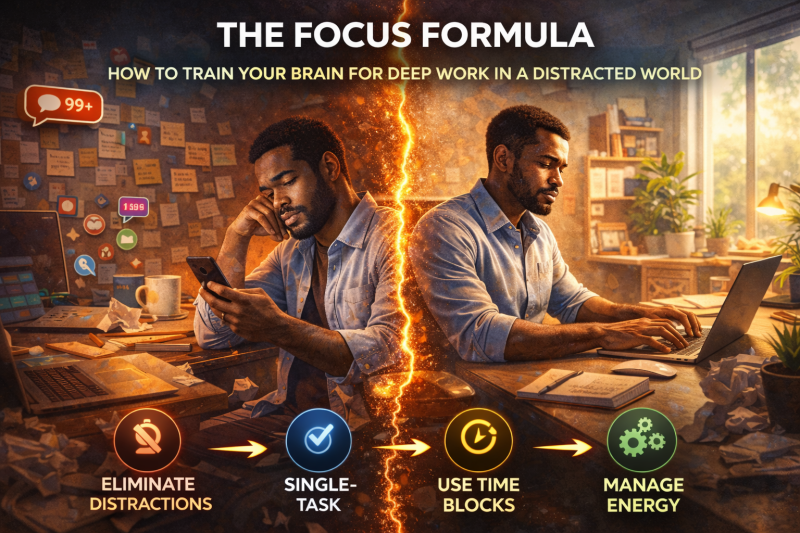
The Focus Formula (Step-by-Step)
Let’s break down how to train your brain for deep work.
Step 1: Eliminate Distractions Before You Start
Most people try to focus while distractions are still present.
That’s like trying to diet with cake sitting in front of you.
What to do:
- turn off notifications
- silence your phone
- close unnecessary tabs
- create a clean workspace
Rule:
Don’t rely on discipline—remove temptation.
Step 2: Train Your Brain to Do One Thing at a Time
Multitasking is a myth.
You’re not doing multiple things—you’re switching rapidly.
And every switch costs energy.
Solution:
Single-task.
One task. One focus. One outcome.
Example:
Instead of:
- writing + checking messages + browsing
Do:
- writing only
Step 3: Use Time Blocks for Deep Work
Your brain works best in focused intervals.
Try this:
- 25–50 minutes of focused work
- 5–10 minutes break
Repeat.
Why it works:
It prevents mental fatigue and keeps your brain engaged.
Step 4: Start With the Hardest Task
Your brain is strongest at the beginning of the day.
Use that energy wisely.
Rule:
Do the most important task first.
Not the easiest. Not the fastest.
The one that actually matters.
Step 5: Build a Focus Ritual
Your brain loves patterns.
When you repeat the same setup, your brain learns:
“Ah… It’s time to focus.”
Example ritual:
- same workspace
- same music (or silence)
- same start time
Consistency builds automatic focus.
Step 6: Manage Your Energy, Not Just Time
Focus requires energy.
No energy = no focus.
Improve energy by:
- getting enough sleep
- taking real breaks
- staying hydrated
- avoiding constant screen overload
Step 7: Reduce Digital Noise
Your phone is the biggest focus killer.
Practical tips:
- move distracting apps off your home screen
- use “Do Not Disturb” mode
- check messages at scheduled times
Humor Break:
Your phone doesn’t ring because it’s important.
It rings because it’s designed to interrupt you.
Step 8: Embrace Boredom
This may sound strange—but it’s powerful.
When you’re always stimulated, your brain loses its ability to focus.
Practice:
- sit without your phone
- allow silence
- resist constant stimulation
Result:
Your brain rebuilds its attention span.
Step 9: Set Clear Goals for Each Session
Vague work kills focus.
Clarity fuels it.
Instead of:
“I’ll work for a while.”
Say:
“I’ll finish this section/task.”
Step 10: Reward Progress (Not Perfection)
Focus improves when your brain sees progress.
After a deep work session:
- take a break
- acknowledge progress
- reset
The Mature Advantage: Focus as a Competitive Edge
In today’s world, focus is rare.
And rare skills are valuable.
For professionals and entrepreneurs:
The ability to focus deeply is:
- a career advantage
- a business advantage
- a life advantage
Reality:
Those who control their attention control their outcomes.
The Focus Trap: Why You Feel Busy but Not Productive
Many people confuse activity with progress.
Signs you’re stuck in shallow work:
- constant checking of emails
- jumping between tasks
- feeling busy but unaccomplished
Solution:
Prioritize impact over activity.
The Focus Formula (Simple Version)
If you remember nothing else, remember this:
- remove distractions
- single-task
- work in focused blocks
- rest intentionally
- repeat daily
Conclusion: Train Your Brain or Lose Your Focus
Focus is not something you “find.”
It’s something you build.
And in a distracted world, building focus is one of the most powerful things you can do.
Because:
The ability to concentrate deeply is the ability to create, grow, and succeed.
Final Thought:
You don’t need more time.
You need better focus.
So the next time you sit down to work, ask yourself:
“Am I in control of my attention—or is something else?”
Then take it back.
One focused session at a time.
Add comment
Comments