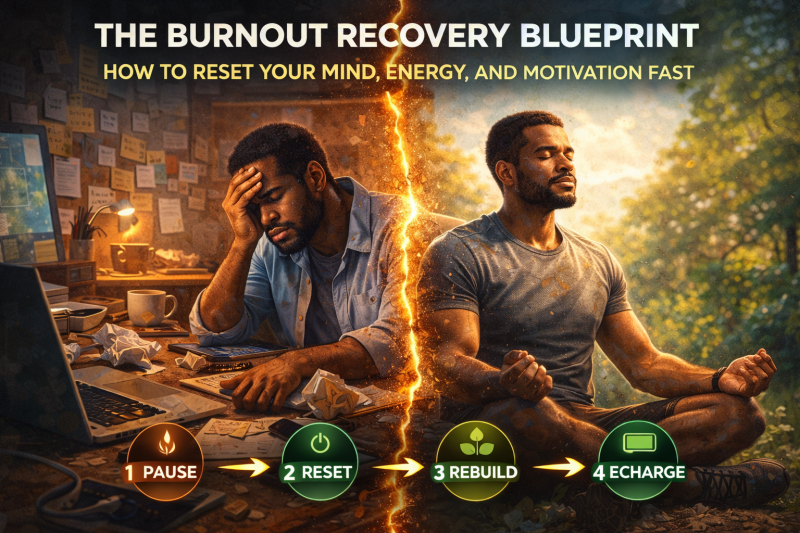
Introduction: When “Tired” Becomes Your Default Setting
There’s tired… and then there’s burnout tired.
- Tired = “I need a nap.”
- Burnout = “Even sleep isn’t fixing this.”
If you’ve ever:
- stared at your screen doing absolutely nothing
- felt unmotivated to do things you once enjoyed
- been “busy all day” but achieved nothing meaningful
…you’re not lazy.
You’re likely burnt out.
And here’s the good news:
Burnout is not permanent. It’s a signal—and signals can be responded to.
What Is Burnout (Really)?
Burnout is a state of:
- emotional exhaustion
- mental fatigue
- reduced motivation
- detachment from work or life
It’s not just stress.
Stress says: “There’s too much going on.”
Burnout says, “I don’t even care anymore.”
The 3 Core Signs of Burnout
- Exhaustion – You feel drained, no matter how much you rest
- Cynicism – You lose interest, passion, or emotional connection
- Inefficiency – Simple tasks feel overwhelming
Humor Break:
Burnout is when your brain says:
“Let’s open 10 tabs… and emotionally close all of them.”
Why Burnout Happens (Especially to High Performers)
Burnout doesn’t usually hit people who are doing nothing.
It hits those who are:
- ambitious
- responsible
- driven
- always “on.”
Common Causes:
- Constant pressure without recovery
- Lack of control over your schedule
- Emotional overload (work + life)
- Perfectionism
- Digital overwhelm
The Burnout Recovery Blueprint (Step-by-Step)
This is not about “taking a day off.”
It’s about resetting your system.
Step 1: Stop Pushing—Start Pausing
Your instinct might be:
“I just need to push through.”
Wrong move.
Burnout doesn’t respond to pressure—it responds to recovery.
What to do:
- Take intentional breaks
- Reduce non-essential tasks
- Allow yourself to slow down
Truth:
You don’t recover from burnout by doing more. You recover by doing less—strategically.
Step 2: Reclaim Your Mental Energy
Burnout is not just about time.
It’s about energy depletion.
Energy drains include:
- constant notifications
- multitasking
- emotional stress
- decision overload
Quick reset strategies:
- turn off unnecessary notifications
- take short “mental breaks” (no screens)
- simplify your daily decisions
Step 3: Fix Your “Input Diet”
What you consume affects how you feel.
If your daily input is:
- negative news
- social media comparison
- constant information overload
Your brain stays in a low-energy, reactive state.
Upgrade your inputs:
- calming music
- uplifting content
- silence (yes, silence counts)
Step 4: Rebuild Motivation (The Right Way)
Here’s the truth:
Motivation doesn’t come first. Action creates motivation.
But when burnt out, action feels hard.
So you start small.
Try this:
- Do 1 simple task
- Keep it short (5–10 minutes)
- Stop before exhaustion
This rebuilds momentum.
Step 5: Reset Your Expectations
Burnout often comes from unrealistic standards.
You expect:
- too much
- too fast
- too perfectly
Reframe:
Instead of:
“I need to be productive all day.”
Try:
“I need to make progress—no matter how small.”
Step 6: Reconnect With Meaning
Burnout disconnects you from purpose.
You start doing things… without knowing why.
Ask yourself:
- Why did I start this?
- What actually matters to me?
- What can I remove that doesn’t align?
Clarity reduces emotional fatigue.
Step 7: Protect Your Recovery Like a Priority
Recovery is not a luxury.
It’s a necessity.
Build recovery into your routine:
- sleep properly (non-negotiable)
- take breaks without guilt
- schedule downtime
Humor Break:
Some people schedule meetings…
But don’t schedule rest.
Then, they wonder why their brain files a complaint.
Step 8: Rebuild Your Daily Structure
Burnout thrives in chaos.
Clarity thrives in structure.
Simple structure:
- 1–3 key priorities per day
- scheduled breaks
- defined start and end times
Step 9: Reduce Decision Fatigue
Burnout worsens when your brain makes too many decisions.
Simplify:
- what to wear
- what to eat
- what to work on
Less decision-making = more mental energy.
Step 10: Be Patient With Yourself
Burnout recovery is not instant.
It’s a process.
Important mindset:
- you’re not broken
- you’re recovering
- progress may be slow—but it’s real
The Mature Perspective: Sustainable Success
For mature professionals and high performers, burnout is often a sign of:
Success without sustainability.
You’ve built momentum—but not systems to maintain it.
The solution is not to slow down permanently.
It’s to build smarter rhythms.
The Burnout Recovery Formula (Simple Version)
If you remember nothing else, remember this:
- Reduce overload
- Restore energy
- Rebuild slowly
- Repeat consistently
Conclusion: You Don’t Need to Quit—You Need to Reset
Burnout makes you feel like everything is the problem.
Your job.
Your routine.
Your goals.
But often, it’s not your life that needs changing.
It’s your system.
You don’t need to abandon your ambition. You need to support it better.
Final Thought:
Burnout is not failure.
It’s feedback.
It’s your mind and body saying:
“Something needs to change.”
Listen to it.
Adjust.
Reset.
And come back stronger—not by force, but by design.
Add comment
Comments