Introduction: “I’ll Do It Later”… Famous Last Words
Let’s start with honesty.
You’ve said it before:
- “I’ll start tomorrow.”
- “Let me just check one thing first.”
- “I work better under pressure anyway.”
Next thing you know, it’s 11:47 PM, you’re watching a video you didn’t plan to watch, and the task you really needed to do is still sitting there… judging you silently.
Welcome to the Procrastination Loop.
And no, you’re not lazy.
You’re human.
What Is Procrastination (Really)?
Procrastination is not about time.
It’s about emotion.
At its core, procrastination is:
Avoiding a task because of how it makes you feel.
Common emotional triggers:
- overwhelm
- fear of failure
- perfectionism
- boredom
- self-doubt
Translation:
You’re not avoiding the task…
You’re avoiding the feeling attached to the task.
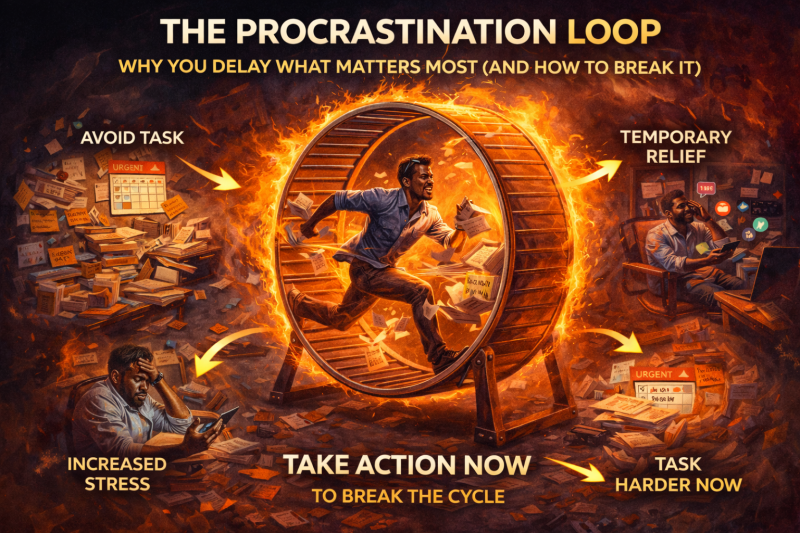
The Procrastination Loop Explained
Here’s how the cycle works:
- You have an important task
- It feels difficult, unclear, or uncomfortable
- You avoid it
- You do something easier (scrolling, chatting, snacks… life happens 😄)
- Temporary relief
- Guilt and stress increase
- The task becomes even heavier
Then the loop repeats.
Humor Break:
Procrastination is like a gym membership.
You have it.
You pay for it.
You think about it…
But somehow… you’re still not using it.
Why You Procrastinate (Even When You Know Better)
Let’s break down the real reasons.
1. The Task Feels Too Big
Your brain sees:
“Write a report.”
And translates it into:
“Climb Mount Everest.”
2. Perfectionism
You don’t want to just do the task.
You want to do it perfectly.
So you delay starting.
3. Lack of Clarity
If you don’t know exactly what to do, your brain resists.
Confusion leads to avoidance.
4. Immediate vs Delayed Rewards
Scrolling = instant reward
Working = delayed reward
Your brain prefers now over later.
5. Fear (The Silent Driver)
- fear of failure
- fear of judgment
- fear of not being good enough
So instead of risking failure… You delay.
The Cost of Procrastination
It may feel harmless—but it adds up.
Hidden consequences:
- missed opportunities
- unnecessary stress
- reduced confidence
- poor performance
- constant mental pressure
Truth:
The longer you delay,
The heavier the task becomes.
The Mind Shift: Action Before Motivation
Most people think:
“I’ll start when I feel motivated.”
But the truth is:
Motivation follows action—not the other way around.
You don’t wait to feel ready.
You start—and then momentum builds.
How to Break the Procrastination Loop
Let’s move from understanding → action.
Step 1: Make the Task Smaller
Big tasks create resistance.
Break them down.
Example:
Instead of:
“Write an essay.”
Do:
- open document
- write one paragraph
Rule:
Make it so small you can’t avoid it.
Step 2: Use the 5-Minute Rule
Tell yourself:
“I’ll do this for just 5 minutes.”
That’s it.
Why it works:
Starting reduces resistance.
And once you start, you often continue.
Step 3: Remove Distractions
Your environment fuels procrastination.
Fix it:
- silence your phone
- close extra tabs
- create a clean workspace
Reality:
You don’t lack discipline—
Your environment is too tempting.
Step 4: Focus on Progress, Not Perfection
Perfection delays action.
Progress creates momentum.
Reframe:
Instead of:
“It has to be perfect.”
Think:
“It just has to be started.”
Step 5: Create Clear Starting Points
Your brain hates ambiguity.
Instead of:
“Work on the project.”
Say:
“Open file and outline first 3 ideas.”
Clarity reduces resistance.
Step 6: Use Time Blocks
Structure reduces procrastination.
Example:
- 30 minutes work
- 5–10 minute break
Repeat.
Step 7: Build Accountability
Tell someone your goal.
Or set deadlines.
Why it works:
External pressure creates action.
Step 8: Reward Completion
Your brain responds to rewards.
After finishing a task:
- take a break
- enjoy something small
- acknowledge progress
Step 9: Understand Your Patterns
Ask yourself:
- When do I procrastinate most?
- What tasks do I avoid?
- Why?
Awareness creates control.
Step 10: Be Kind—but Firm With Yourself
You don’t need to punish yourself.
But you do need to be honest.
Mature mindset:
“I may not feel like doing this…
But I will do it anyway.”
The Mature Advantage: Discipline Over Mood
For mature professionals, success comes from:
Doing what needs to be done—regardless of how you feel.
Not every task will be exciting.
Not every day will feel productive.
But consistency beats emotion.
The Procrastination Escape Formula
If you remember nothing else, remember this:
- make it small
- start quickly
- remove distractions
- focus on progress
- repeat daily
Conclusion: Start Before You Feel Ready
Procrastination is not a character flaw.
It’s a pattern.
And patterns can be broken.
Final Thought:
You don’t need more time.
You need more stars.
Because the hardest part is not finishing.
It’s beginning.
So the next time you catch yourself saying:
“I’ll do it later…”
Pause and ask:
“What’s one small step I can take right now?”
Then take it.
Immediately.
Add comment
Comments