Introduction: The Willpower Myth
Let’s get one thing straight.
If breaking bad habits were simply about willpower…
You would have already done it.
- You know what to do
- You’ve tried to do it
- You’ve promised yourself you’ll do better
And yet… somehow…
You’re back in the same cycle.
Scrolling. Delaying. Snacking. Avoiding.
Here’s the truth:
Habits don’t change because of willpower.
They change because of structure.
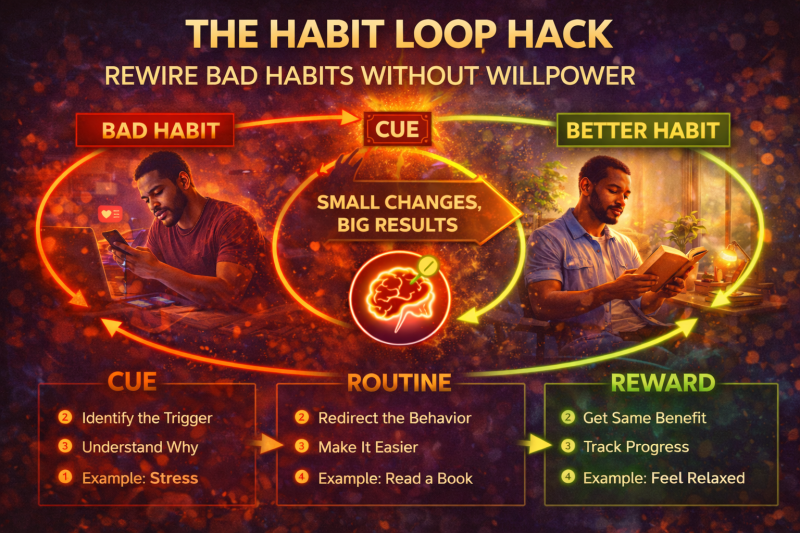
What Is the Habit Loop?
Every habit—good or bad—follows a simple pattern:
🔁 Cue → Routine → Reward
- Cue – the trigger
- Routine – the behavior
- Reward – the benefit your brain gets
Example:
- Cue: You feel bored
- Routine: You grab your phone
- Reward: You feel entertained
Humor Break:
Your brain doesn’t care if it’s productive.
It just wants to know:
“Did we get a reward? Yes? Let’s do that again tomorrow.”
Why Bad Habits Stick So Easily
Bad habits are not random.
They are efficient.
They:
- require little effort
- give instant rewards
- are easily repeated
Meanwhile, good habits:
- require effort
- have delayed rewards
- feel uncomfortable at first
Translation:
Your brain chooses:
easy now > better later
The Real Problem: Fighting the Habit Instead of Rewiring It
Most people try to:
- stop the behavior
- resist the urge
- rely on discipline
But this rarely works long-term.
Why?
Because:
You can’t remove a habit—you can only replace it.
The Habit Loop Hack (Step-by-Step)
Let’s break this down into something practical.
Step 1: Identify the Cue
Every habit starts with a trigger.
Common cues:
- boredom
- stress
- environment
- time of day
- emotions
Example:
You snack late at night.
Ask:
“What triggers this?”
- hunger?
- boredom?
- routine?
Step 2: Keep the Reward—Change the Routine
This is the key hack.
Don’t fight the reward.
Redirect the behavior.
Example:
Instead of:
- scrolling endlessly
Try:
- watching something intentionally
- reading
- taking a short walk
Rule:
Same cue. Same reward. New behavior.
Step 3: Reduce Friction for Good Habits
Make good habits easier to do.
Example:
- place a book on your desk
- prepare your workout clothes
- keep healthy snacks visible
Step 4: Increase Friction for Bad Habits
Make bad habits harder.
Example:
- log out of social media
- move apps off your home screen
- keep your phone away while working
Humor Break:
If your phone is in another room…
Suddenly you “remember” how to focus 😄
Step 5: Start Small (Very Small)
Big changes fail.
Small changes stick.
Instead of:
“I’ll work out for 1 hour daily.”
Start with:
“I’ll do 5 minutes.”
Why it works:
Small wins build consistency.
Consistency builds identity.
Step 6: Use Environment Design
Your environment shapes your habits more than motivation does.
Example:
- clean workspace → better focus
- clutter → distraction
- quiet → deep thinking
Truth:
You don’t rise to your goals.
You fall into your environment.
Step 7: Stack Habits Together
Attach a new habit to an existing one.
Example:
- After brushing teeth → read for 5 minutes
- After coffee → start your main task
This makes habits automatic.
Step 8: Track Your Progress
What gets tracked gets improved.
Simple method:
- mark daily completion
- track streaks
Bonus:
Your brain loves progress.
Step 9: Expect Resistance
Change is uncomfortable.
That’s normal.
Important mindset:
“It’s supposed to feel hard in the beginning.”
Step 10: Focus on Identity
This is where real transformation happens.
Instead of:
“I’m trying to break this habit.”
Say:
“I am becoming someone who…”
- focuses
- follows through
- takes action
The Mature Perspective: Systems Over Willpower
For mature professionals and high performers:
Success is not built on motivation.
It’s built on systems.
Systems create:
- consistency
- structure
- predictability
Truth:
You don’t need more discipline.
You need better systems.
The Habit Trap: All-or-Nothing Thinking
Many people quit because:
- they miss one day
- they break a streak
- they feel like they “failed.”
Reality:
Missing once is a mistake.
Quitting is the problem.
Rule:
Never miss twice.
The Habit Formula (Simple Version)
If you remember nothing else:
- identify the cue
- change the routine
- keep the reward
- adjust your environment
- stay consistent
Conclusion: Rewire, Don’t Resist
Breaking bad habits is not about fighting yourself.
It’s about understanding yourself.
Final Truth:
Your habits are not who you are.
They are patterns you’ve learned.
And what is learned…
Can be changed.
So the next time you fall into a habit you want to break, don’t say:
“I lack discipline.”
Ask:
“What loop am I running—and how can I redesign it?”
Then start small.
Stay consistent.
And let the system do the work.
Add comment
Comments