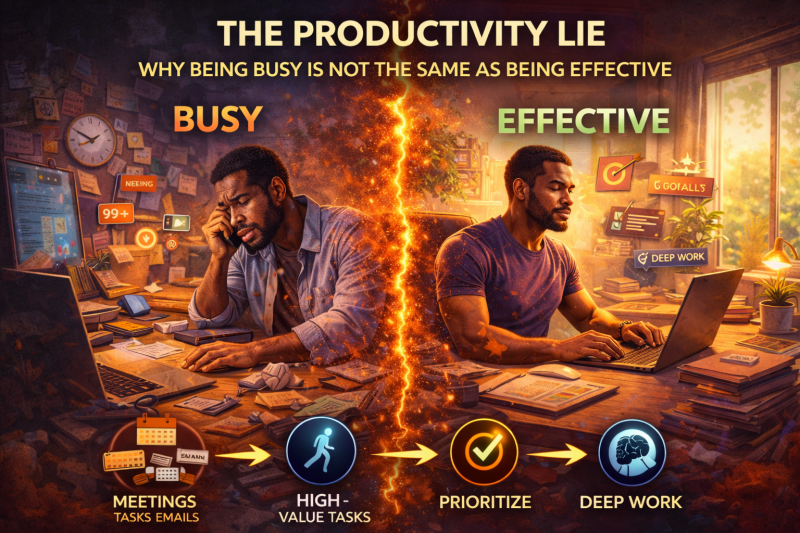
Introduction: The Badge of “Busy”
Ask someone how they’re doing, and you’ll often hear:
“I’ve been busy.”
It’s become a badge of honor.
Busy = important
Busy = productive
Busy = successful
But here’s the uncomfortable truth:
Being busy is often a distraction from being effective.
You can spend an entire day working…
and still accomplish nothing that truly matters.
Busy vs Productive: The Critical Difference
Let’s break it down.
Busy People:
- do many tasks
- respond quickly
- stay constantly active
- feel overwhelmed
Productive People:
- focus on high-impact work
- prioritize effectively
- eliminate distractions
- create meaningful results
Truth:
Busyness is about motion.
Productivity is about progress.
Why We Confuse Busy With Productive
There are psychological reasons behind this trap.
1. Activity Feels Like Progress
When you’re doing something, it feels like you’re moving forward.
Even if that “something” is not important.
2. Immediate Feedback
Answering emails, replying to messages, attending meetings—these give quick satisfaction.
But they rarely move the needle.
3. Social Validation
Being busy sounds impressive.
“I'm fully booked” sounds better than:
“I focused deeply and finished one important task.”
Humor Break:
Some people have calendars so full…
Even their break time needs to be scheduled two weeks in advance 😄
The Productivity Lie in Action
Let’s paint a picture.
A Typical “Busy” Day:
- Check emails (multiple times)
- Attend meetings
- Respond to messages
- Jump between tasks
- Scroll “just for a minute.”
End of day feeling:
“I did a lot… but what did I actually accomplish?”
A Truly Productive Day:
- Focus on 1–3 important tasks
- Complete meaningful work
- Limit distractions
- Create tangible results
End of day feeling:
“I moved forward.”
The Real Cost of Busyness
Being busy may feel productive—but it comes with hidden costs.
1. Shallow Work Dominance
You spend more time on low-value tasks than meaningful work.
2. Mental Exhaustion
Constant switching drains your brain.
3. Lack of Progress
You stay active—but stagnant.
4. Burnout Risk
Busyness without results leads to frustration and fatigue.
The Productivity Shift: From Busy to Effective
The goal is not to do more.
The goal is to do what matters most.
Step 1: Identify High-Impact Work
Ask yourself:
“What tasks actually move my life or work forward?”
Examples:
- writing a proposal
- building a strategy
- studying deeply
- creating something valuable
Rule:
If it doesn’t create progress, question its importance.
Step 2: Prioritize Ruthlessly
Not all tasks are equal.
The 80/20 Principle:
- 20% of your efforts create 80% of your results
Focus on that 20%.
Step 3: Eliminate or Reduce Low-Value Tasks
Not everything needs your attention.
Reduce:
- unnecessary meetings
- constant email checking
- low-priority tasks
Truth:
Productivity is not just about what you do—
It’s about what you stop doing.
Step 4: Embrace Deep Work
Real productivity happens in focused, uninterrupted time.
Create space for:
- thinking
- creating
- problem-solving
Step 5: Stop Multitasking
Multitasking is productivity’s biggest enemy.
Reality:
You’re not multitasking.
You’re just switching tasks… poorly.
Step 6: Set Clear Outcomes
Don’t just work.
Work toward a result.
Instead of:
“I’ll work on this project.”
Say:
“I will complete this section today.”
Step 7: Protect Your Time
Your time is your most valuable resource.
Set boundaries:
- limit interruptions
- schedule focus blocks
- say no when necessary
Humor Break:
If everything is urgent…
Nothing is important 😄
Step 8: Measure Output, Not Effort
Stop asking:
“How busy was I?”
Start asking:
“What did I actually complete?”
Step 9: Build a Simpler Work System
Complex systems create overwhelm.
Simple systems create clarity.
Example:
- 3 priorities per day
- focused work blocks
- scheduled breaks
Step 10: Redefine Productivity
Productivity is not about doing more.
It’s about doing what matters most—consistently.
The Mature Perspective: Effectiveness Over Activity
For mature professionals and leaders, this shift is critical.
Success is not built on:
- constant activity
- endless hustle
- being “always busy.”
It’s built on:
Clarity, focus, and meaningful execution.
The Productivity Formula (Simple Version)
If you remember nothing else:
- focus on high-impact tasks
- eliminate distractions
- work deeply
- measure results
- repeat daily
Conclusion: Stop Running—Start Moving Forward
Being busy feels productive.
But it’s often just motion without direction.
Final Truth:
You don’t need to do more.
You need to do what matters.
So the next time you feel overwhelmed, pause and ask:
“Am I being busy… or am I being effective?”
Then adjust.
Because real success is not about how much you do—
It’s about what you actually achieve.
Add comment
Comments