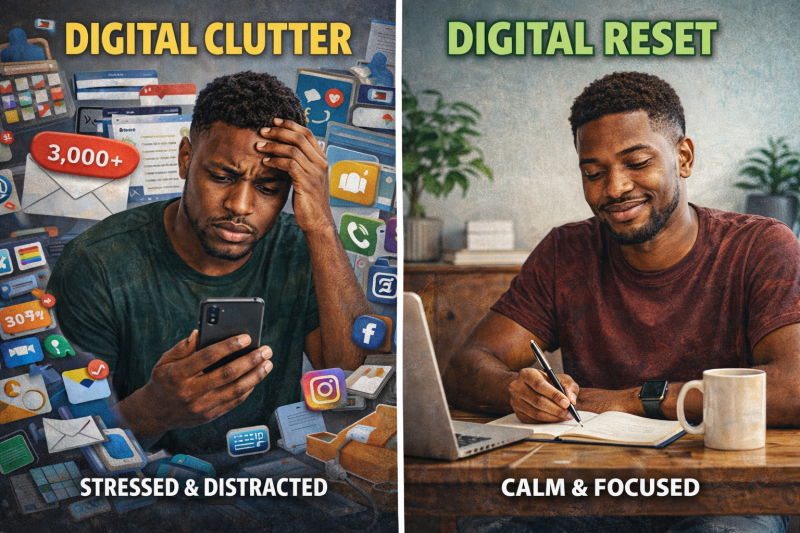
Introduction: The Stress You Can’t See
Most people think clutter only exists in physical spaces — messy rooms, crowded desks, or overflowing closets.
But one of the biggest sources of modern stress is digital clutter.
Your phone, laptop, and online accounts may be overloaded with:
- Thousands of unread emails
- Dozens of apps
- Hundreds of notifications
- Endless files and downloads
- Constant social media updates
Even if you don’t notice it consciously, digital clutter increases mental stress and reduces focus.
Your brain experiences digital clutter the same way it experiences physical clutter — as unfinished business.
The result is hidden stress and constant distraction.
What Is Digital Clutter?
Digital clutter is the buildup of unnecessary digital information that overwhelms your attention.
Examples include:
- Unread emails
- Old photos
- Duplicate files
- Unused apps
- Browser tabs
- Notifications
- Downloads
- Old messages
Many people carry thousands of digital items they no longer need.
Your devices become digital storage rooms that never get cleaned.
Why Digital Clutter Causes Stress
Your brain prefers order and clarity.
When your digital environment is messy, your brain feels overwhelmed.
Even seeing:
- 3,000 unread emails
- 40 open tabs
- Constant notifications
creates mental pressure.
Your brain interprets clutter as unfinished tasks.
This creates a background sense of anxiety.
You may not feel it clearly, but it affects your mood and productivity.
The Hidden Mental Cost of Screen Overload
Modern devices constantly demand attention.
Notifications interrupt your thinking.
Messages pull your focus.
Apps compete for your time.
Your brain never gets a chance to rest.
This creates cognitive overload.
Cognitive overload reduces:
- Memory
- Focus
- Decision-making
- Creativity
Many people feel mentally tired even without doing physical work.
Screen overload is often the reason.
The Notification Trap
Notifications are one of the biggest sources of digital stress.
Every notification signals:
"Something needs your attention."
Even when you ignore notifications, your brain registers them.
Constant interruptions increase stress hormones and reduce concentration.
Example
You sit down to study or work.
Your phone vibrates every few minutes.
Even without checking it, your focus is broken.
Productivity drops.
Stress increases.
Too Many Choices Drain Your Brain
Digital clutter creates too many decisions.
Every time you open your phone, you must decide:
- Which message to read
- Which app to open
- Which file to use
- Which task to do
Too many choices lead to decision fatigue.
Decision fatigue reduces energy and motivation.
A simple phone check becomes mentally exhausting.
Digital Clutter and Sleep Problems
Many people check their phones late at night.
Screens expose your eyes to bright light that disrupts sleep patterns.
Notifications also keep your brain alert.
Poor sleep leads to:
- Low energy
- Poor focus
- Irritability
- Stress
Digital clutter affects not only your day but also your night.
Signs You Have Digital Clutter
You may have digital clutter if:
- Your email inbox is overwhelming
- Your phone has too many apps
- You constantly receive notifications
- Your files are disorganized
- Your desktop is messy
- You have too many browser tabs open
- You feel stressed using your devices
Many people experience these symptoms without realizing the cause.
The Benefits of Digital Organization
Organizing your digital life reduces stress.
Benefits include:
- Better focus
- Clear thinking
- Faster work
- Less distraction
- More control
A clean digital environment supports a calm mind.
How to Reduce Digital Clutter
You do not need to remove technology from your life.
You need to organize it.
1. Clean Your Email Inbox
Start with email.
Delete:
- Spam
- Old promotions
- Unnecessary messages
Unsubscribe from emails you never read.
A smaller inbox feels lighter.
2. Reduce Notifications
Turn off non-essential notifications.
Keep only:
- Important messages
- Important reminders
- Work or school alerts
Fewer interruptions improve focus.
3. Delete Unused Apps
Many people have dozens of unused apps.
Remove apps you do not use.
Fewer apps mean fewer distractions.
4. Organize Files and Folders
Create simple folders:
- School
- Work
- Personal
- Documents
Organized files save time and reduce stress.
5. Limit Open Tabs
Too many tabs overwhelm your brain.
Try keeping fewer than:
- 5–10 tabs open
Close the rest.
Your mind will feel clearer.
6. Schedule Digital Breaks
Take breaks from screens.
Examples:
- No phone during meals
- No screens before sleep
- One hour offline daily
Digital breaks restore mental energy.
The Power of a Digital Reset
Sometimes the best solution is a full reset.
Spend one hour:
- Cleaning your phone
- Organizing files
- Deleting apps
- Clearing emails
Many people feel immediate relief after organizing their devices.
A digital reset creates mental space.
Your Brain Needs Simplicity
Technology is powerful, but too much information overwhelms the mind.
Your brain works best with:
- Clear spaces
- Simple systems
- Limited distractions
Simplifying your digital life improves your mental life.
Conclusion: Clean Devices, Clear Mind
Digital clutter is one of the hidden stresses of modern life.
Even if you do not notice it, it affects your:
- Focus
- Mood
- Energy
- Productivity
Reducing digital clutter is one of the easiest ways to improve mental clarity.
You do not need to eliminate technology.
You only need to control it.
A cleaner digital space creates a calmer mind.
Start small.
Delete one app.
Organize one folder.
Turn off one notification.
Small changes create big relief.
Add comment
Comments