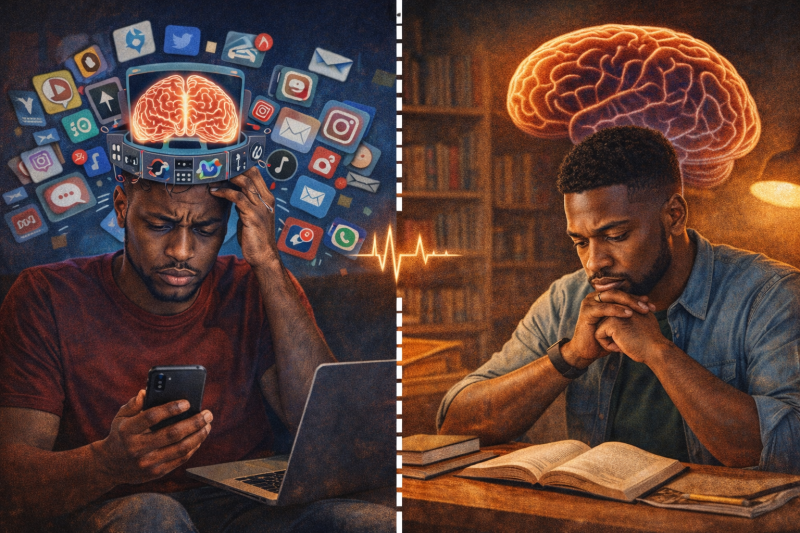
Introduction: When Did Focusing Become So Hard?
Let’s try a quick experiment.
Think about the last time you sat down to read something long—maybe a book, a report, or even a thoughtful article online.
Did you finish it without checking your phone?
Or did you suddenly remember you needed to:
- Check one email
- Reply to a message
- Look up something unrelated
- Watch a “quick” video
And somehow 25 minutes later, you’re watching a documentary about deep-sea octopuses.
If this sounds familiar, you’re not alone.
Many adults—professionals, students, entrepreneurs, even seasoned readers—are noticing something strange:
Focusing deeply feels harder than it used to.
This isn’t laziness. It’s not a lack of intelligence.
Something deeper is happening.
Your attention span is being trained every day by the digital environment around you.
And unfortunately, the training program is not designed for your benefit.
Welcome to the Attention Economy
In the modern digital world, attention is the most valuable resource.
Not oil.
Not gold.
Not even data.
Your attention.
Every social media platform, news site, streaming service, and mobile app competes for the same limited asset:
Your focus.
The longer you stay engaged, the more ads you see. The more ads you see, the more money companies make.
So tech companies invest billions of dollars into one question:
How do we keep people looking at the screen longer?
The result is a highly engineered digital ecosystem designed to capture—and hold—your attention.
The Dopamine Loop: Your Brain’s Reward System
To understand why digital platforms are so effective, we need to talk about dopamine.
Dopamine is a neurotransmitter in the brain associated with:
- pleasure
- motivation
- reward
- anticipation
When something pleasurable happens, your brain releases dopamine.
Examples include:
- Eating your favorite meal
- Receiving praise
- Winning a game
- Getting a compliment
- Seeing someone “like” your post
Your brain loves dopamine.
So naturally, it tries to repeat behaviors that trigger it.
Technology companies know this.
The Slot Machine in Your Pocket
If you’ve ever wondered why checking your phone feels oddly addictive, there’s a reason.
The design principles behind many apps are similar to those used in casinos.
Casinos use something called variable rewards.
You don’t win every time you pull a slot machine lever.
But occasionally you do.
That unpredictability keeps people playing.
Social media platforms work the same way.
Every time you refresh your feed, you might see:
- Something funny
- Something shocking
- Something inspiring
- Something controversial
Or something completely useless.
But occasionally you see something really interesting.
Your brain receives a small dopamine reward.
So you keep scrolling.
The Rise of Micro-Content
Short-form content has exploded across the internet.
TikTok videos.
Instagram Reels.
YouTube Shorts.
Clips that last anywhere from 5 seconds to 60 seconds.
This format delivers rapid bursts of stimulation.
Your brain becomes accustomed to fast, high-intensity information.
The downside?
Longer, slower activities begin to feel difficult.
Reading books.
Studying complex ideas.
Deep thinking.
These require patience.
But your brain has been trained to expect speed.
The Multitasking Myth
Many people pride themselves on multitasking.
Answering emails, checking messages, and watching a video while working on a report.
But neuroscience tells a different story.
The brain does not truly multitask.
Instead, it switches rapidly between tasks.
Each switch forces the brain to refocus.
And each refocus costs mental energy.
Over time, this constant switching leads to:
- fatigue
- reduced concentration
- lower productivity
In short, multitasking makes you feel busy—but accomplish less.
The Mature Adult’s Dilemma
For mature audiences—professionals, leaders, entrepreneurs—the attention problem can be particularly frustrating.
You may remember a time when:
- Reading a book for hours felt natural
- Watching a full lecture was easy
- Studying complex ideas was enjoyable
Now you sit down to focus and suddenly feel restless.
Your phone buzzes.
Your email pings.
A notification pops up.
Your brain jumps toward the distraction almost automatically.
It’s not a weakness.
It’s conditioning.
The Hidden Cost of Constant Distraction
Attention is more than just concentration.
It affects nearly every aspect of mental performance.
When attention declines, several things happen:
Memory Suffers
Your brain struggles to retain information if attention keeps shifting.
Creativity Declines
Creative insights often require uninterrupted thought.
Constant interruptions block that process.
Decision-Making Weakens
A distracted mind struggles to evaluate complex choices.
Stress Increases
Too much digital stimulation overloads the nervous system.
Ironically, the tools designed to make life easier often make it mentally noisier.
A Moment of Humor: The Modern Brain
Modern attention habits can be amusing when you step back and observe them.
You open your phone to check the weather.
Thirty minutes later, you’ve:
- watched three cooking videos
- read about a celebrity you’ve never heard of
- learned ten “life hacks” you’ll never use
- and checked the weather in a city you’re not even visiting
Meanwhile, the original reason you opened the phone is long forgotten.
Technology is incredible.
But sometimes our relationship with it resembles a distracted goldfish.
Can Your Attention Be Recovered?
The encouraging news is that attention is trainable.
Just as your brain adapted to constant stimulation, it can relearn deeper focus.
The key is intentional habits.
Strategies to Rebuild Focus
1. Turn Off Non-Essential Notifications
Most notifications are not urgent.
Reducing them dramatically improves mental calm.
2. Schedule Deep Focus Periods
Try working in uninterrupted blocks of 30–60 minutes.
No phone. No social media.
Just one task.
3. Create Tech-Free Zones
Certain parts of your day can be protected from digital noise.
Examples include:
- meals
- early mornings
- the hour before sleep
4. Reintroduce Long-Form Content
Train your brain with slower information again.
Books. Long articles. Lectures.
Your attention span will gradually improve.
5. Use Technology Intentionally
Technology should serve your goals—not control your behavior.
Ask yourself:
“Is this helping me or distracting me?”
That simple question can change habits.
The Real Advantage in a Distracted World
In a world where attention is constantly fragmented, the ability to focus deeply is becoming a rare skill.
And rare skills create powerful advantages.
People who can concentrate longer tend to:
- learn faster
- think more clearly
- produce better work
- make stronger decisions
Focus is becoming a modern superpower.
Conclusion: Protect Your Attention
Your attention determines the quality of your thinking.
Your thinking shapes your actions.
And your actions shape your life.
The digital world will continue competing for your focus.
But the responsibility for protecting it ultimately belongs to you.
So the next time you feel the urge to check your phone for the tenth time in an hour, pause and ask yourself:
Is my attention serving me—or someone else’s algorithm?
Because in the modern economy, attention isn’t just valuable.
It’s priceless.
Add comment
Comments