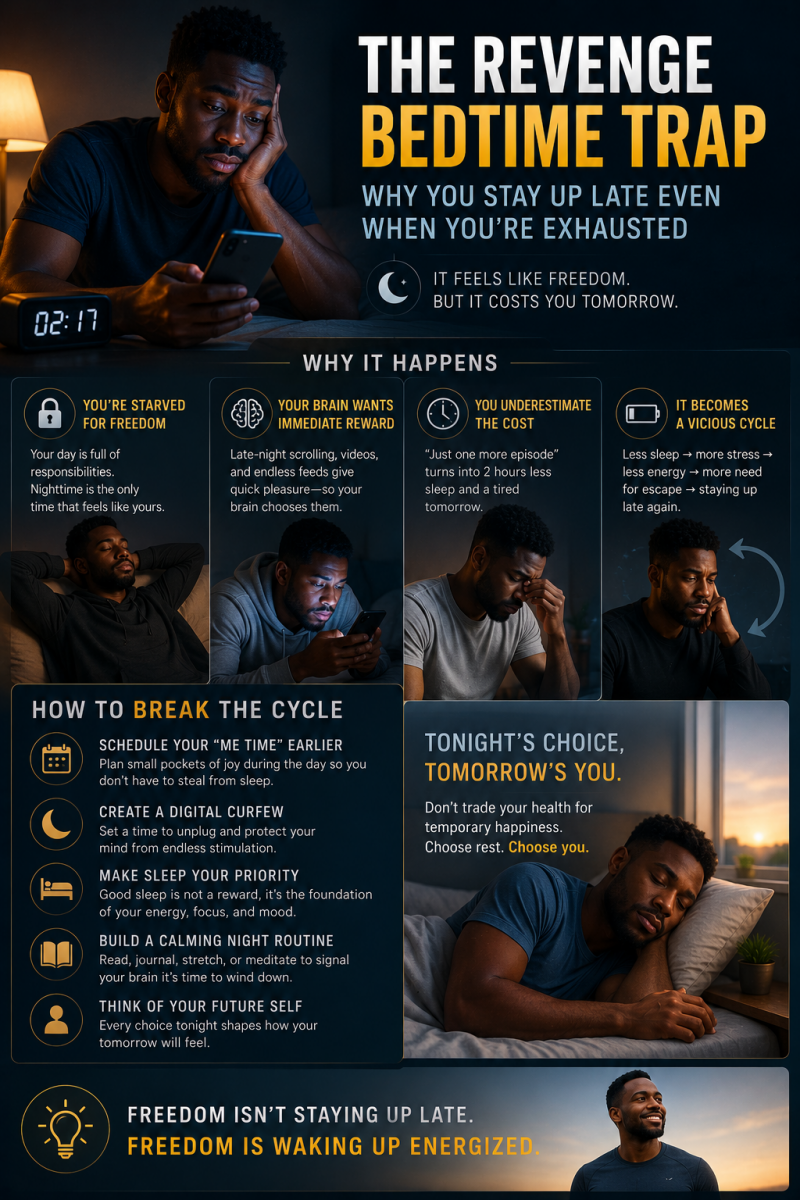
Introduction: The Midnight Rebellion
You’re exhausted.
Your eyes feel heavy.
You’ve been tired since about 2:00 PM.
You know you should go to bed.
Tomorrow is another busy day.
And yet...
There you are at 11:47 PM.
Scrolling.
Watching videos.
Checking social media.
Reading random articles about ancient civilizations, productivity hacks, or why cats behave like tiny dictators.
Midnight arrives.
Then 1:00 AM.
Then somehow 2:00 AM.
Even though you know you'll regret it tomorrow, you keep going.
Why?
If you're asking yourself:
"Why do I stay up late when I'm already exhausted?"
You're not alone.
You may be experiencing something psychologists and researchers call:
Revenge Bedtime Procrastination
A growing phenomenon affecting millions of adults worldwide.
And surprisingly, it has less to do with laziness and more to do with something deeper:
The desire to reclaim control over your life.
What Is Revenge Bedtime Procrastination?
Revenge bedtime procrastination occurs when people delay sleep to enjoy personal leisure time after a long day of obligations.
In simple terms:
You stay awake because it's the only part of the day that feels like yours.
Even though sleep would be healthier.
Even though you're exhausted.
Even though tomorrow's version of you is begging for mercy.
Humor Break
Nighttime You:
"I deserve some relaxation."
Morning You:
"I would like to file a formal complaint." 😄
Why We Do It
Most people don't intentionally decide:
"Tonight I shall sabotage tomorrow's energy levels."
The behavior is usually emotional, not logical.
Let's explore why.
Reason #1: Your Day Doesn't Feel Like Your Own
Many adults spend most of their waking hours:
- working
- commuting
- caregiving
- handling responsibilities
- solving problems
- responding to others
By evening, they feel depleted.
More importantly...
They feel deprived of personal freedom.
Result:
The brain seeks compensation.
And bedtime becomes the target.
Important Truth
Sleep procrastination is often a rebellion against a life that feels overly controlled.
Reason #2: You're Starving for Personal Time
Humans need autonomy.
We need moments that belong entirely to us.
When the day lacks:
- hobbies
- relaxation
- enjoyment
- creativity
- personal choice
People often steal those moments from sleep.
The thought process:
"I've worked all day."
"I deserve some time."
"I'll just stay up a little longer."
Unfortunately, "a little longer" often turns into another hour or two.
Reason #3: Digital Entertainment Is Designed to Keep You Awake
Modern technology is incredibly effective at capturing attention.
Social media platforms.
Streaming services.
Online videos.
Gaming.
News feeds.
They're all designed to encourage continued engagement.
Translation:
You're not weak.
You're competing against billion-dollar attention systems.
Humor Break
Netflix has never once asked:
"Shouldn't you be getting some sleep?" 😄
Reason #4: Sleep Feels Like the End of Freedom
This may sound strange.
But for many adults, bedtime feels symbolic.
Sleep means:
- tomorrow is coming
- responsibilities return
- work begins again
- obligations continue
Staying awake creates the illusion of extending freedom.
Even if only briefly.
The Hidden Cost of Sleep Procrastination
The problem is that this strategy creates a vicious cycle.
You stay up late.
↓
You get less sleep.
↓
You feel tired tomorrow.
↓
Work feels harder.
↓
You feel more deprived.
↓
You crave more personal time.
↓
You stay up late again.
And the cycle continues.
What Sleep Deprivation Actually Does to Your Brain
Many people underestimate the impact of poor sleep.
Sleep affects:
- memory
- concentration
- emotional regulation
- decision-making
- productivity
- mood
Lack of sleep can increase:
- irritability
- anxiety
- stress
- brain fog
- cravings
- emotional sensitivity
Important Reminder
You don't become more productive by borrowing time from sleep.
You simply become more tired.
Why "Just One More Episode" Feels So Powerful
At night, your brain is already fatigued.
Mental self-control weakens.
This makes it harder to resist immediate rewards.
Example:
At 9:00 AM:
"Of course I'll go to bed early tonight."
At 12:45 AM:
"Maybe one more video won't matter."
😄
The Psychology of Immediate Gratification
Humans naturally prioritize immediate pleasure over future benefits.
Immediate reward:
Entertainment now.
Future reward:
Energy tomorrow.
Unfortunately, the brain often favors now over later.
The Stress Connection
People under high stress are especially vulnerable to revenge bedtime procrastination.
Why?
Because stress creates a stronger desire for escape.
Common escape activities:
- binge-watching
- scrolling
- gaming
- online shopping
- endless internet browsing
These activities provide temporary relief.
But they often worsen fatigue.
The Freedom Deficit
Many experts believe the root issue isn't sleep.
It's freedom.
People who feel satisfied and balanced during the day are less likely to steal time from sleep.
Important Insight
The real problem isn't bedtime.
It's what happens before bedtime.
How to Break the Revenge Bedtime Trap
Let's focus on practical solutions.
Step 1: Schedule Personal Time Earlier
Don't make bedtime the only enjoyable part of your day.
Create intentional moments for:
- hobbies
- reading
- exercise
- relaxation
- creativity
Even small amounts help.
Step 2: Create a Digital Sunset
Choose a time when screens begin shutting down.
Example:
No social media after 10 PM.
No streaming after 10:30 PM.
Simple boundaries make a huge difference.
Step 3: Make Sleep Feel Rewarding
Many people view sleep as something they're losing time to.
Reframe it.
Sleep is:
- recovery
- performance enhancement
- emotional maintenance
- energy restoration
Truth
Sleep is not wasted time.
It's preparation for a better tomorrow.
Step 4: Reduce Decision Fatigue
The more exhausted your brain becomes, the harder it is to make good decisions.
Simplify evenings.
Create routines.
Reduce unnecessary choices.
Step 5: Address the Real Problem
Ask yourself:
What am I actually craving at night?
Is it:
- freedom?
- relaxation?
- entertainment?
- peace?
- control?
The answer reveals what needs attention.
Step 6: Create a Wind-Down Ritual
Help your brain transition into rest.
Effective options:
- reading
- journaling
- prayer
- stretching
- calming music
- meditation
Signals matter.
Your brain benefits from predictable routines.
Step 7: Remember Your Future Self
Before scrolling another hour, ask:
How will Tomorrow Me feel about this decision?
Future You deserves consideration too.
Humor Break
Future You has been sending warning messages for years.
Present You keeps leaving them on "read." 😄
The Bigger Lesson
Revenge bedtime procrastination reveals something important:
People don't merely need sleep.
They need balance.
They need joy.
They need autonomy.
They need moments that belong to them.
When those needs are ignored, sleep often becomes the sacrifice.
The Freedom Formula
If you remember nothing else:
More Daytime Satisfaction = Less Nighttime Revenge
The goal isn't simply going to bed earlier.
The goal is creating a life you don't constantly feel the need to escape from.
The Mature Perspective on Rest
As we grow older, many of us realize:
Rest is not laziness.
Recovery is not weakness.
Sleep is not an obstacle to success.
It is one of the foundations of it.
The most productive people are often not those who work the longest.
They are those who recover the smartest.
Conclusion: Stop Stealing From Tomorrow
If you've fallen into the revenge bedtime trap, don't be too hard on yourself.
You're not lazy.
You're not undisciplined.
You're human.
You're trying to reclaim something many modern adults lack:
A sense of personal control.
Final Truth
Staying awake gives the illusion of freedom.
But true freedom is waking up energized, healthy, focused, and ready for the life you're building.
So tonight, instead of stealing hours from tomorrow...
Consider giving a gift tomorrow.
A rested mind.
A recharged body.
And the sleep you've been postponing.
Because sometimes the most productive thing you can do is simply go to bed.
Add comment
Comments