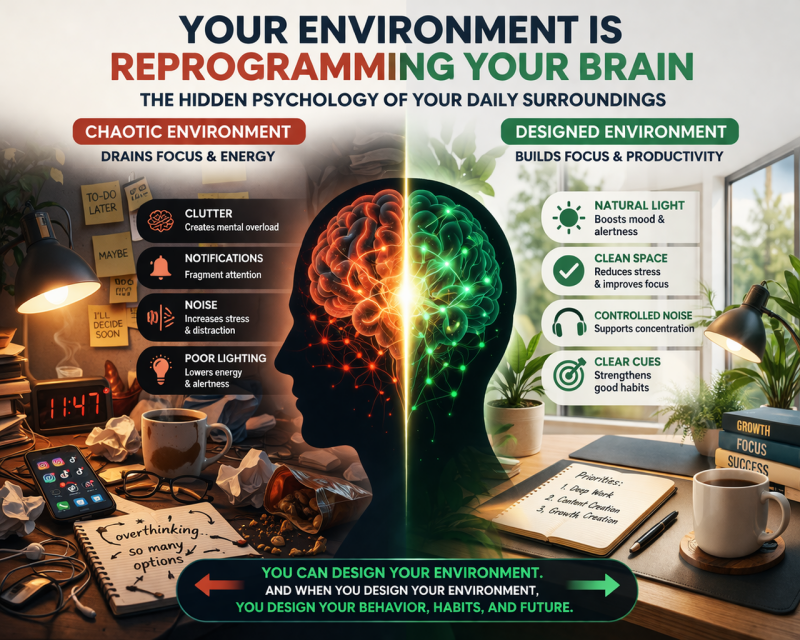
Introduction: Your Environment Is Not Neutral
Take a moment and look around you.
Your desk.
Your room.
Your phone.
Your workspace.
Now ask yourself:
Is this environment helping me succeed—or quietly working against me?
Most people think success is about discipline, motivation, or willpower.
But here’s the uncomfortable truth:
Your environment often has more influence over your behavior than your intentions.
In other words, your surroundings are constantly programming your brain, whether you realize it or not.
What Is Environmental Psychology?
Environmental psychology is the study of how physical surroundings influence human behavior, thinking, and emotions.
It explores how things like:
- lighting
- noise
- clutter
- layout
- colors
- digital environments
affect how we think, feel, and act.
And here’s the key insight:
You don’t just live in your environment—Your environment lives in you.
The Invisible Influence of Your Space
Your brain is constantly scanning your surroundings.
Without conscious awareness, it is asking:
- “What should I focus on?”
- “What actions are easy here?”
- “What behaviors are encouraged?”
This means your environment subtly guides your behavior.
Example:
If your phone is next to you while working → you check it more often.
If snacks are visible → you eat more.
If your workspace is clean → you focus better.
Your environment creates default behaviors.
The Power of Habit Environments
Habits don’t just depend on motivation.
They depend on context.
This is known as behavior design—structuring your environment to make good habits easier and bad habits harder.
Think about this:
- A messy desk invites distraction
- A quiet space invites focus
- A cluttered phone invites scrolling
- A structured workspace invites productivity
Your environment is like a silent coach.
Unfortunately, sometimes it’s coaching you in the wrong direction.
Clutter: The Silent Stress Generator
Clutter is not just physical.
It’s psychological.
When your space is disorganized, your brain processes it as unfinished tasks.
This creates mental tension.
You may not consciously think about it—but your brain feels it.
Signs of clutter overload:
- difficulty concentrating
- feeling overwhelmed
- low motivation
- mental fatigue
Humor Break:
A cluttered desk is basically your brain saying:
“Let’s do everything… and nothing… at the same time.”
Lighting: The Hidden Energy Switch
Lighting plays a major role in how your brain functions.
- Bright, natural light increases alertness
- Dim lighting can signal relaxation (or sleep mode)
If your workspace is poorly lit, your brain may struggle to stay energized.
Your brain responds to light as a biological signal.
Translation:
Bad lighting = low energy
Good lighting = higher focus
Noise: The Background That Shapes Your Mind
Noise is another powerful environmental factor.
Too much noise creates distraction.
Too little stimulation can feel dull.
The ideal balance:
- Quiet for deep work
- Soft background noise for light tasks
Example:
Trying to focus while someone is talking loudly nearby is like trying to read a book while someone is reading a different book out loud.
Your brain doesn’t appreciate the competition.
The Digital Environment: The New Living Space
Your environment is no longer just physical.
Your digital environment plays an equally powerful role.
Your phone, apps, notifications, and screens are part of your daily surroundings.
Consider this:
- Notifications = interruptions
- Social media = distraction triggers
- Endless apps = attention fragmentation
Your digital space can either support focus or destroy it.
Behavior Design: Make Good Habits Easy
If you want to improve your habits, don’t just rely on discipline.
Design your environment.
1. Reduce Friction for Good Habits
Make positive behaviors easier.
Example:
- Keep books visible → read more
- Keep your workspace organized → focus more
2. Increase Friction for Bad Habits
Make distractions harder.
Example:
- Move apps off your home screen
- Keep your phone out of reach
3. Create Zones
Design spaces for specific purposes:
- Work zone → focus only
- Relaxation zone → rest only
Your brain learns to associate each space with behavior.
The Environment vs. Willpower Debate
Many people believe success is about willpower.
But willpower is limited.
The environment is constant.
Example:
If junk food is on your desk, you’ll eventually eat it.
Not because you lack discipline—but because your environment makes it easy.
Key insight:
Environment beats willpower over time.
Reprogramming Your Space
If your environment has been shaping your behavior, the good news is:
You can redesign it.
Simple changes that create a big impact:
- Clean your workspace
- Improve lighting
- Reduce noise distractions
- Organize your digital space
- Remove unnecessary clutter
Small changes → big behavioral shifts.
The Mature Advantage
For mature audiences—professionals, entrepreneurs, leaders—this insight is powerful.
You don’t need to rely on motivation alone.
You can engineer your surroundings for success.
Instead of asking:
“How do I stay disciplined?”
Ask:
“How do I design an environment where discipline becomes easier?”
Conclusion: Design Your Space, Design Your Life
Your environment is constantly influencing:
- your habits
- your focus
- your energy
- your decisions
The question is not whether your environment affects you.
It’s whether you are intentionally shaping it.
Because ultimately:
Your environment shapes your behavior, your behavior shapes your habits, and your habits shape your life.
So take a look around.
What is your environment teaching you right now?
And more importantly—
Add comment
Comments