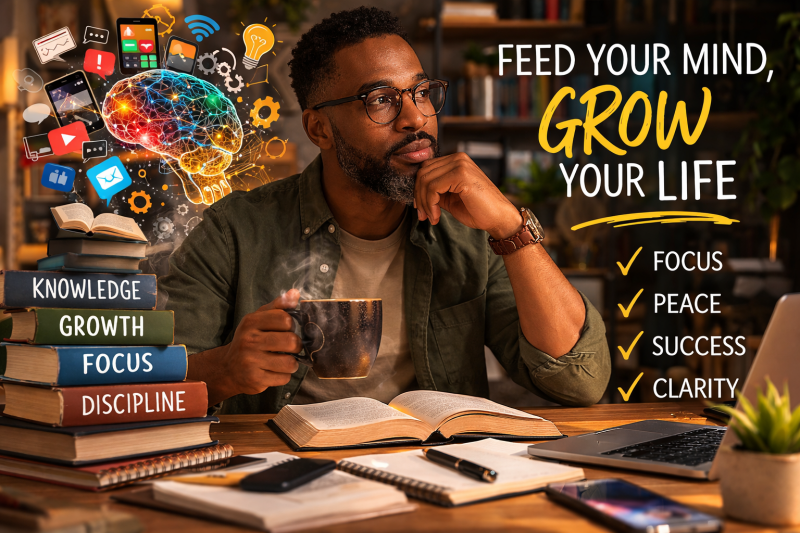
Introduction: Your Brain Is Always Eating Something
Most people are careful about what they eat.
They think about calories, nutrition, sugar intake, and healthy choices.
But there is another type of diet most of us completely ignore:
Our mental diet.
Every day, your brain consumes an enormous amount of information:
- News headlines
- Social media posts
- Emails and messages
- Podcasts and videos
- Conversations and opinions
Just like food affects your body, information affects your mind.
And if your brain is constantly consuming junk information, the results can be surprisingly similar to eating junk food all day.
You may feel:
- mentally tired
- emotionally drained
- distracted
- anxious
In other words, your brain may be suffering from information overload.
What Is a Mental Diet?
A mental diet refers to the type and quality of information you consistently expose your mind to.
Think of your brain as a sponge.
It absorbs everything around it—ideas, emotions, beliefs, and narratives.
Over time, the information you consume begins to shape:
- your mindset
- your mood
- your decisions
- your worldview
If your mental diet is healthy and balanced, your thinking becomes clearer and more productive.
But if your mental diet is full of negativity, noise, and distractions, your thinking becomes cluttered.
The Age of Information Overload
Human brains evolved in a world where information arrived slowly.
Centuries ago, people received information through:
- books
- letters
- conversations
- occasional news
Today, the situation is dramatically different.
Modern technology delivers thousands of pieces of information daily.
Notifications buzz.
News updates appear every hour.
Social media scrolls endlessly.
Your brain is constantly processing input.
It’s like trying to drink water from a fire hose.
Why Information Overload Is Draining Your Brain
Your brain has a limited capacity to process information.
Psychologists call this cognitive load.
When too much information arrives too quickly, your brain struggles to filter what truly matters.
The result is mental fatigue.
You may notice symptoms such as:
- difficulty concentrating
- decision fatigue
- reduced creativity
- increased stress
Ironically, even though we have more information than ever before, many people feel less mentally clear.
The Emotional Impact of Your Information Diet
Information doesn’t just influence what you think.
It influences how you feel.
For example:
Constant exposure to negative news may increase anxiety.
Endless social media comparisons may reduce confidence.
Fast-paced entertainment may reduce patience for slower activities like reading or deep thinking.
Your emotional state often reflects the emotional tone of the information you consume.
Humor Break: The Modern Information Buffet
Imagine your brain walking into a restaurant called “The Internet Buffet.”
The menu looks like this:
- Breaking news about global crises
- Celebrity gossip
- Productivity hacks
- 30-second comedy videos
- Fitness inspiration
- Conspiracy theories
- Cat videos
Your brain piles everything onto one giant plate.
Twenty minutes later, it’s confused, overwhelmed, and slightly worried about the state of the world.
This is essentially how modern information consumption works.
We consume everything, without filtering.
How Your Mental Diet Shapes Your Decisions
Information influences more than just mood—it affects behavior.
For example:
If you constantly read about financial opportunities, you start thinking about investment and growth.
If you consume endless negativity, your brain may begin expecting problems everywhere.
If you expose yourself to learning and ideas, your thinking expands.
Over time, your mental diet becomes a framework for how you interpret reality.
The Algorithm Problem
Another challenge in the digital age is the role of algorithms.
Platforms such as social media use algorithms designed to show you content that keeps you engaged.
Unfortunately, engagement often favors content that is:
- dramatic
- controversial
- emotionally intense
Because these types of content trigger strong reactions.
This can create an information environment where your brain is constantly exposed to extreme opinions, conflict, and sensational stories.
Which is great for clicks.
But not great for cognitive health.
The Productivity Cost of Digital Noise
Information overload doesn’t just affect mood.
It also affects productivity.
Many professionals spend large portions of their day managing:
- emails
- messages
- notifications
- digital updates
Instead of doing deep work.
Your brain repeatedly switches between tasks.
This constant switching reduces efficiency and increases mental fatigue.
The result?
You feel busy all day but accomplish less meaningful work.
Designing a Healthy Mental Diet
Just like improving physical health requires dietary choices, improving cognitive health requires intentional information consumption.
Here are practical strategies.
1. Be Selective About News
Stay informed—but not overwhelmed.
Choose a few reliable sources instead of constantly checking headlines.
2. Limit Social Media Scrolling
Social media is designed to capture attention.
Setting time limits helps prevent mental overload.
3. Prioritize High-Quality Information
Read books, long-form articles, and thoughtful content that expands your thinking.
Your brain benefits from depth, not just speed.
4. Create Mental Quiet Time
Your brain needs moments without constant input.
Quiet activities such as walking, journaling, or reflection help process ideas.
5. Ask One Simple Question
Before consuming content, ask:
“Is this feeding my mind or just filling my time?”
That one question can dramatically improve your mental diet.
The Long-Term Impact of a Healthy Mental Diet
When you improve your mental diet, several changes begin to happen.
You may notice:
- clearer thinking
- improved focus
- better emotional balance
- stronger decision-making
Your brain becomes less reactive and more intentional.
Instead of being controlled by information, you begin choosing what shapes your mind.
Conclusion: Feed Your Mind Wisely
The information you consume today becomes the mindset you carry tomorrow.
Just as healthy food fuels a strong body, healthy information fuels a strong mind.
In a world overflowing with content, the real skill is not consuming more information.
It is about choosing the right information.
Because ultimately your mental diet determines not just what you know—but who you become.
So the next time you open your phone, ask yourself:
“Is this nourishing my mind—or just entertaining it?”
Your brain will thank you for the difference.
Add comment
Comments